TL;DR
-
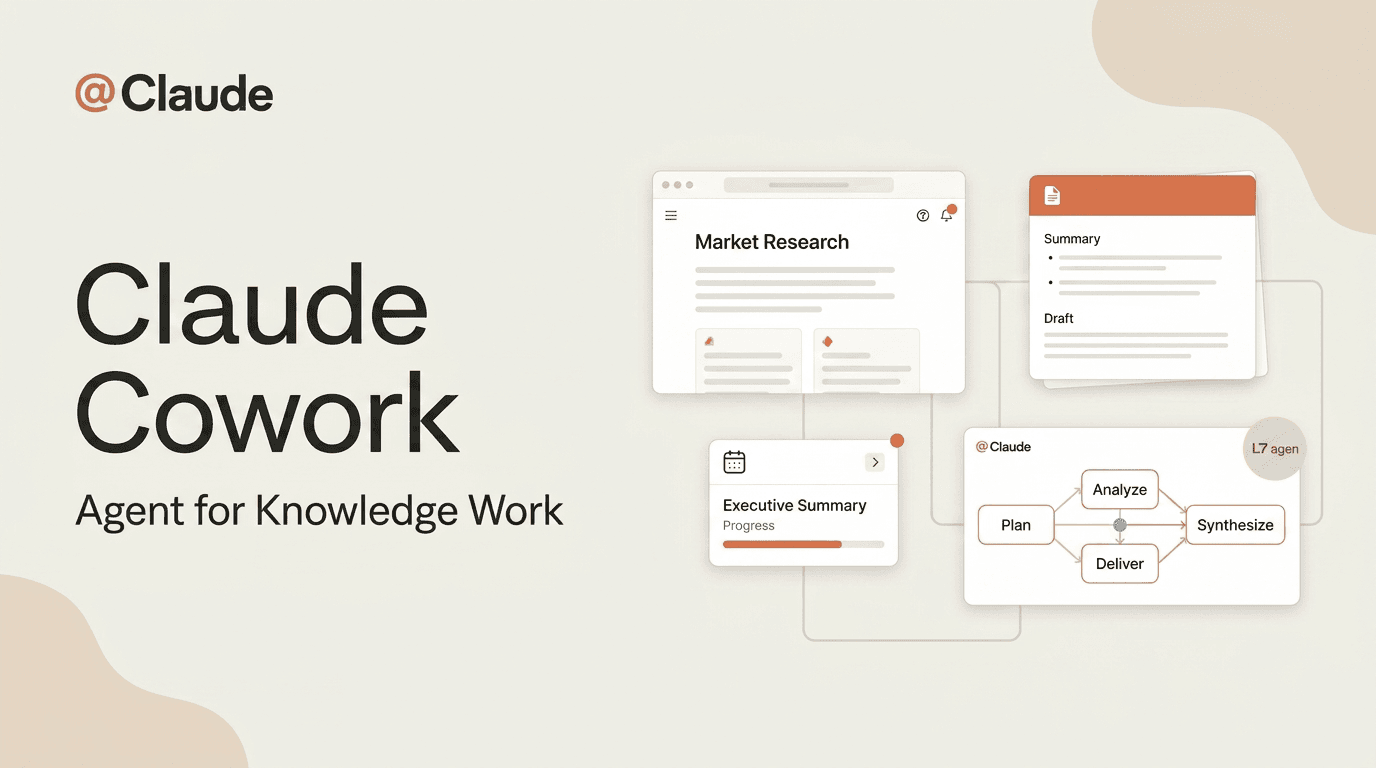
Claude Cowork is Anthropic's agentic layer for non-coding knowledge work: you describe an outcome, Claude plans and executes multi-step tasks across local files, connected apps, and (when needed) your browser — then delivers polished outputs for your review.
-
It shares the same agentic architecture as Claude Code but targets research, analysis, document creation, and operational workflows rather than software engineering — with a GUI instead of a terminal.
-
Cowork runs on Claude Desktop (macOS and Windows), web , and mobile (beta as of mid-2026); paid plans include Pro, Max, Team, and Enterprise. Remote sessions let work continue when your laptop is closed.
-
Cowork is user-initiated : you open a task and assign work. It is not a calendar runtime that pushes prep before meetings unless you schedule tasks yourself.
-
For a structured comparison of Cowork replacements by category, see our companion piece on the best Claude Cowork alternatives.
1. Why Claude Cowork Exists Now
1.1 From Answers to Deliverables
For most of 2023–2025, "using AI at work" meant typing into a chat window. Claude Chat, ChatGPT, and Gemini excelled at drafting, brainstorming, and explaining — but the last mile stayed manual. You copied the answer into a spreadsheet, reorganized the folder yourself, or pasted research into a slide deck. The model responded; you still operated the toolchain.
Anthropic saw a different pattern inside Claude Code , its terminal-based agent for developers. Engineers were delegating multi-step work — read files, run commands, edit across a codebase, verify output — and coming back to finished artifacts rather than instructions. Non-developers started adopting the same capabilities for file organization, research synthesis, and document assembly, even though the terminal interface was never designed for them.
Claude Cowork, announced as a research preview in January 2026 and expanded through enterprise releases in the first half of 2026, is Anthropic's answer: the same agentic execution model, wrapped in the Claude desktop and web experience, aimed at knowledge work beyond coding. The product guide frames it explicitly as the path from conversational AI — question, answer, manual follow-through — to delegated work where Claude "carries multi-step tasks through to real deliverables."
That shift matters because the bottleneck for many solo operators is not reasoning quality. It is execution bandwidth : the time between deciding something should happen and having a reviewable output in the right folder or app. Cowork targets that gap.
1.2 Where Cowork Sits in Anthropic's Product Line
Anthropic now presents three surfaces inside Claude, each optimized for a different job:
Surface | Primary user | What you delegate |
|---|---|---|
Chat | Anyone | Drafting, Q&A, exploration — one turn at a time |
Claude Code | Developers | Code generation, debugging, repo-wide changes via terminal or IDE |
Claude Cowork | Knowledge workers | Multi-step tasks across files, apps, and scheduled cadences |
Cowork is not a separate model. It is a product mode built on Claude's agentic stack — plan, tool use, subtasks, long-running execution — with permissions and UX tuned for operational work rather than pair programming. Understanding that distinction prevents the common confusion between "Claude on my desktop" (Chat) and "Claude doing work on my desktop" (Cowork). A fourth surface, Claude Tag, brings the same loop into Slack as a shared teammate; the full split across all three agents is in Claude Code vs Cowork vs Tag.
2. Claude Cowork Defined
2.1 The Core Definition
Claude Cowork is an agentic task mode inside Claude where you describe a goal and desired outcome, Claude creates a plan, executes across the files and tools you authorize, and returns finished work — documents, organized folders, spreadsheets, research briefs — for your approval. Unlike Chat, Cowork can read, edit, and create files in folders you specify, run multi-step workflows without you re-prompting every step, and (on supported plans) continue work in remote sessions while you are away from your desk.
The official help center states that Cowork uses the same agentic architecture as Claude Code, without requiring a terminal. Execution runs remotely in beta: Claude's work happens in an isolated environment on Anthropic's servers, sessions sync to your Claude account, and the desktop app bridges to local files or your browser when a task needs assets on your machine.
2.2 Five Defining Properties
Outcome-oriented delegation. You specify what should exist when the task is done — a four-slide metrics deck, a renamed audit folder, a meeting brief — not a sequence of micro-prompts. Cowork analyzes the request, breaks complex work into subtasks when needed, and coordinates parallel workstreams. Anthropic's product page describes this as "say what, not how": Claude figures out the steps.
Scoped file and tool access. On desktop, Cowork reads and writes local files in folders you choose. Through connectors and plugins, it can reach apps such as Slack, Google Drive, and CRM systems depending on your plan and admin settings. You decide the scope; Claude cannot reach paths or integrations you did not authorize. Deletions require explicit approval in the default permissions model.
Visible execution. Cowork surfaces the plan, files opened, tools used, and intermediate choices. You can steer mid-task or let it run independently — a design response to agent safety concerns, since Cowork takes real actions rather than only suggesting them.
Long-running and scheduled work. Tasks can run for extended periods without chat-style context timeouts. Scheduled tasks run on a cadence you define — weekly campaign decks, recurring reports — and remote execution means scheduled work can complete without a device online, according to Anthropic's documentation as of July 2026.
Cross-surface continuity. Chat and Cowork share one home in the Claude app: you select "Cowork" from the same message box used for Chat. Remote sessions follow your account across desktop, web, and mobile (beta), so you can start at your desk and review on your phone.
2.3 What Claude Cowork Is Not
Boundary clarity prevents category mistakes that drive bad tool choices.
Cowork is not Claude Chat with file upload. Chat responds to messages; it does not persistently operate inside your filesystem or connected apps to complete end-to-end tasks. The official FAQ draws this line directly: in Chat, Claude cannot access your files directly; in Cowork, it can complete tasks inside authorized folders.
Cowork is not Claude Code. Code lives in the terminal and IDEs, optimized for repositories, tests, and deployments. Cowork targets non-coding knowledge work — research, analysis, document creation, operational multi-step jobs — using the same agentic approach but different defaults and integrations.
Cowork is not a calendar-driven agent OS. It can help with meeting prep if you connect CRM, calendar, and messaging apps and either start a task or schedule one — Anthropic's product guide lists research briefs and meeting prep among seven common workflows. But the default trigger is you opening Cowork and assigning work , not your 9:00am client call automatically routing a prep pipeline. Architectures that treat calendar events as the runtime belong to a different product category; for that contrast, see Calendar-Driven AI vs Chat-Based AI.
Cowork is not an open-source desktop agent. Projects such as Eigent, OpenWork, and Open Cowork implement Cowork-like local multi-agent stacks with BYOK and hackable codebases. Anthropic's Cowork is a closed commercial product inside the Claude subscription boundary. We cover that ecosystem separately in the best Claude Cowork alternatives comparison linked from the TL;DR above.
Cowork is not Claude Tag. Tag is a multiplayer Slack coworker with organization identity and ambient follow-up; Cowork is a single-player desktop agent for your own files. Both wear "coworker" language, which is the source of most category confusion.
3. Chat vs Code vs Cowork — When to Use Which
Choosing the wrong surface wastes time and subscription limits. Anthropic's own product matrix (June 2026 product guide) reduces the decision to intent and interface , not model quality.
Use Chat when the work is conversational: explore an idea, rewrite a paragraph, ask for an explanation, iterate in short turns. Chat is the lowest-friction surface and consumes usage limits more slowly than Cowork for equivalent session length, according to Anthropic's Pro plan pricing page as of July 2026.
Use Claude Code when the artifact is code: features, fixes, refactors, tests, infrastructure scripts. Code expects comfort with terminals or IDE extensions and grants deep repository access. If your job is shipping software, Code is the purpose-built path; Cowork will feel like the wrong tool even though both are "agents."
Use Claude Cowork when the deliverable is operational knowledge work: organize a folder of contracts, build a spreadsheet from exports, synthesize research into a formatted doc, prepare materials for a meeting from connected apps, or run a recurring report on a schedule. Cowork fits episodic, file- and app-heavy batches that you initiate — or schedule explicitly — rather than pair-programming sessions.
The following table summarizes trigger, output, and typical user; verify current platform support on Anthropic's official pages before committing to a workflow.
Dimension | Chat | Claude Code | Claude Cowork |
|---|---|---|---|
Trigger | You send a message | You invoke agent in terminal/IDE | You start a Cowork task or schedule |
Primary output | Text in the thread | Code changes, commits, scripts | Files, decks, sheets, organized folders |
File access | Manual upload/paste | Full repo / workspace | User-selected folders + connectors |
Best-fit user | General knowledge work | Software engineers | Ops, marketing, legal, finance, solo founders |
Interface | Message box | Terminal, VS Code, JetBrains | Cowork mode in Claude app + web/mobile beta |
When in doubt, ask whether the job ends in a merged pull request (Code), a polished file in a folder you chose (Cowork), or a paragraph you will paste somewhere else (Chat). That single question resolves most surface confusion.
4. How Cowork Compares to Related Concepts
Cowork did not invent desktop agents. It commercialized a pattern — local files, multi-step autonomy, Anthropic-native safety and connectors — that open-source projects and adjacent architectures had been exploring in parallel.
Desktop cowork clones (open source). Eigent, OpenWork, Open Cowork, and PawWork position themselves as local-first or Cowork-inspired desktops with model choice, BYOK, and inspectable code. They trade Anthropic's polish and single-vendor billing for flexibility and data sovereignty. Cowork remains the reference implementation for "what Anthropic thinks a knowledge-work agent should feel like" inside Claude.
Chat-based assistants with tools. ChatGPT Projects, Gemini with Workspace, and Claude Chat with artifacts handle fragments of the same job — research, drafting, file analysis — but typically require you to pull work forward turn by turn. Cowork's differentiation is end-to-end task ownership with less copy-paste assembly.
Calendar-driven proactive agents. A separate architecture treats calendar events and deadlines as triggers: prep runs before calls, follow-ups after, deliverables ahead of due dates without you reopening an agent surface. That model answers "what should happen because this event exists?" rather than "what should happen when I assign a task?" The agentic calendar category formalizes the calendar-as-runtime idea; Cowork can participate in meeting workflows via connectors, but its design center remains user- or schedule-initiated task delegation, not event-native execution. Solopreneurs whose week is mostly recurring client calls and deadline blocks sometimes combine both layers — Cowork for ad-hoc file projects, calendar-driven agents for rhythm work — rather than treating either as a full replacement.
Workflow automation (Zapier, Make, n8n). Static if-this-then-that recipes excel at reliable, repeatable integrations. Cowork excels at judgment-heavy multi-step work where the steps depend on file contents and context. The categories overlap at the edges (scheduled Cowork tasks vs scheduled Zaps) but differ in adaptability versus predictability.
5. Who Should Use Cowork — and Who Should Not
Cowork earns its subscription cost when your work produces reviewable artifacts from messy inputs — folders, exports, scattered notes — and you value Anthropic's integrated connectors and permission model over assembling your own agent stack.
Strong fits include operators who run recurring operational batches (weekly metrics decks, contract triage, campaign exports), consultants who live in local files and client folders, and team leads who want delegated research or document assembly without hiring a coordinator for every small project. Anthropic's enterprise positioning emphasizes cross-app passes — query Slack and Databricks in one run, per customer quotes on the product page — which matters when your pain is scattered tools, not missing intelligence.
Cowork is a weaker default when your calendar is sparse and work is mostly async deep thinking with two meetings a month; Chat or a lightweight desktop clone you open occasionally may suffice. It is also the wrong first pick when you require fully local, auditable open-source agent code for policy reasons — evaluate open-source Cowork alternatives instead. Finally, if your primary failure mode is forgetting to prep before calls or ship follow-ups after them, a user-initiated desktop agent will not fix forgetting; architectures that trigger from the calendar address a different root cause, as described in our AI scheduling agent overview.
Pricing shape matters: Cowork is included in paid Claude plans (Pro from roughly $17–20/month depending on billing, Max tiers at $100 and $200/month, Team and Enterprise per-seat pricing as listed on Anthropic's Cowork product page, July 2026). Anthropic notes Cowork consumes usage limits faster than Chat; heavy delegators should plan for Max tiers or Team budgets.
6. What's Next for Desktop Agent Work
Cowork's trajectory in 2026 points toward enterprise-grade deployment — admin controls, OpenTelemetry monitoring, plugin marketplaces, remote sessions across web and mobile — while agent safety for real-world actions remains an active research area. Anthropic's documentation explicitly warns that Cowork activity is not yet captured in audit logs or the Compliance API as of mid-2026, which matters for regulated buyers even as OTel hooks mature.
The broader market is splitting into three durable paths: vendor-native cowork surfaces (Cowork, Copilot Cowork, similar enterprise bundles), open-source desktop agents with BYOK and local control, and trigger-diverse agents where calendars, channels, or schedules — not a single chat box — initiate work. Cowork solidifies the first path. It does not subsume the other two.
Plugins and connectors extend Cowork's reach without turning it into a general automation platform. Anthropic's plugin marketplace bundles skills, connectors, and sub-agents for roles such as marketing, legal, and finance — domain packs that reduce cold-start prompting for recurring professional workflows. That direction suggests Cowork will compete as much on ecosystem depth (which apps and playbooks ship by default) as on raw model capability, especially inside Team and Enterprise accounts where admins curate private marketplaces.
For readers evaluating the full landscape, start with this definition, then move to categorized alternatives and scenario-specific tools rather than assuming one product replaces every agent workflow on your machine.
Conclusion
Claude Cowork is Anthropic's agent mode for delegated knowledge work: same agentic engine as Claude Code, GUI-first experience, scoped access to your files and connected apps, and support for long-running and scheduled tasks across desktop, web, and mobile beta. It is not Chat with extra buttons, not a replacement for Claude Code, and not inherently calendar-driven — it is the surface you use when you want to hand Claude a goal and return to finished output.
Pick Chat for conversational drafting, Code for repositories, Cowork for operational deliverables. If Cowork's limits — subscription lock-in, user-initiated triggers, closed codebase — push you elsewhere, treat that as a category decision, not a failure of the product's design center.
Frequently Asked Questions
Is Claude Cowork the same as Claude Desktop?
How much does Claude Cowork cost?
Can Claude Cowork run when my laptop is closed?
What's the difference between Claude Cowork and Claude Code?
Does Claude Cowork replace calendar automation or meeting prep tools?
What kinds of tasks is Claude Cowork actually good at?
https://floatboat.ai/blog/what-is-claude-cowork