
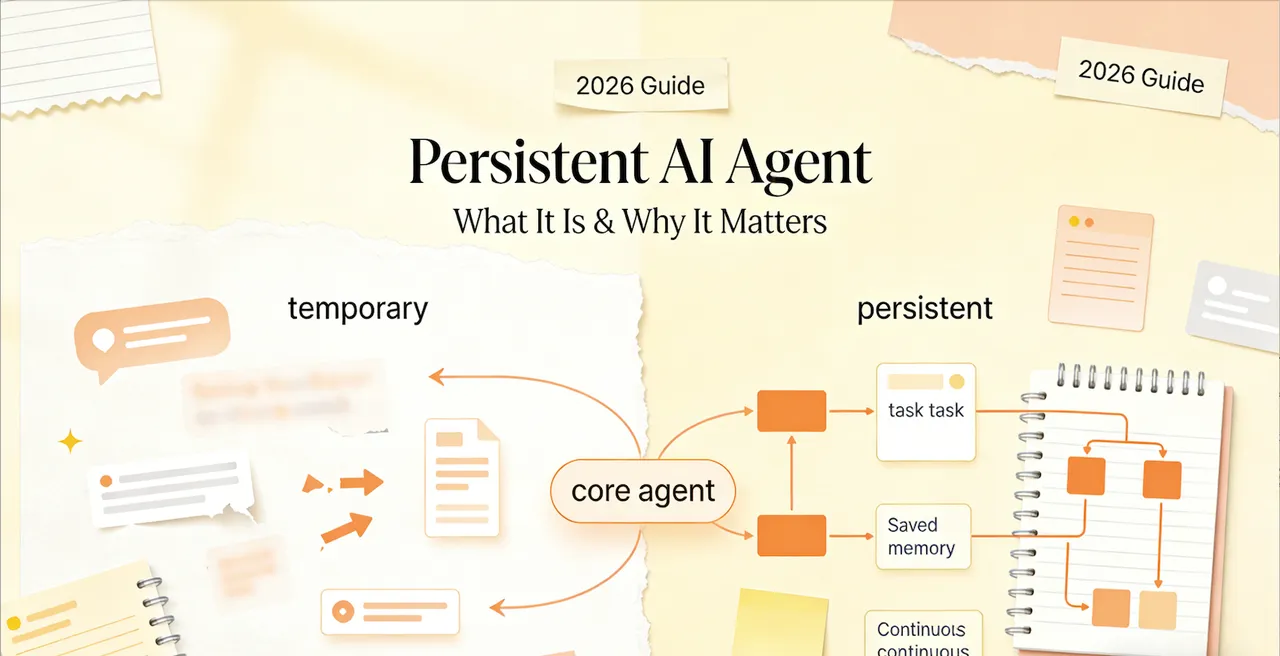
A persistent AI agent can continue useful work after a chat turn, process restart, or human wait—but only because a system around the model stores and restores the right state. Persistence is not a property of an LLM by itself, and it is not synonymous with a long chat history.
That distinction matters. “The agent remembers” might mean it can reread this conversation, recover a half-finished workflow, retrieve a preference from last month, or query the current customer record. Those capabilities require different stores, permissions, retention rules, and tests. Combining them under one memory label creates systems that feel convenient until they recall the wrong fact or repeat a consequential action.
This guide separates the layers, shows a practical architecture, and explains when persistence is useful—and when a stateless assistant is safer.
A precise definition of a persistent AI agent
A persistent AI agent is an agent whose authorized state can survive beyond one model invocation and be recovered for a later step, run, or session. It usually has three properties:
- Durable identity: the system can associate the next request with the correct user, tenant, project, task, or workflow.
- Durable state: selected information is stored outside the model context and can be restored after interruption.
- Controlled continuation: the system knows what may resume automatically, what must be recomputed, and what requires human approval.
Persistence does not mean the agent remembers everything, learns correctly from every interaction, or runs forever. A sound design persists only what has a defined purpose, owner, lifetime, and deletion path.
Seven concepts that are often confused with memory
1. Session context
Session context is the message and tool history available during one conversation or short-lived session. It helps resolve references such as “use the second option.” When the context window fills, the application may trim, summarize, or retrieve older turns.
This is continuity, but not necessarily long-term persistence. A summary can omit detail, and a longer context window does not guarantee that every included fact will influence the answer correctly.
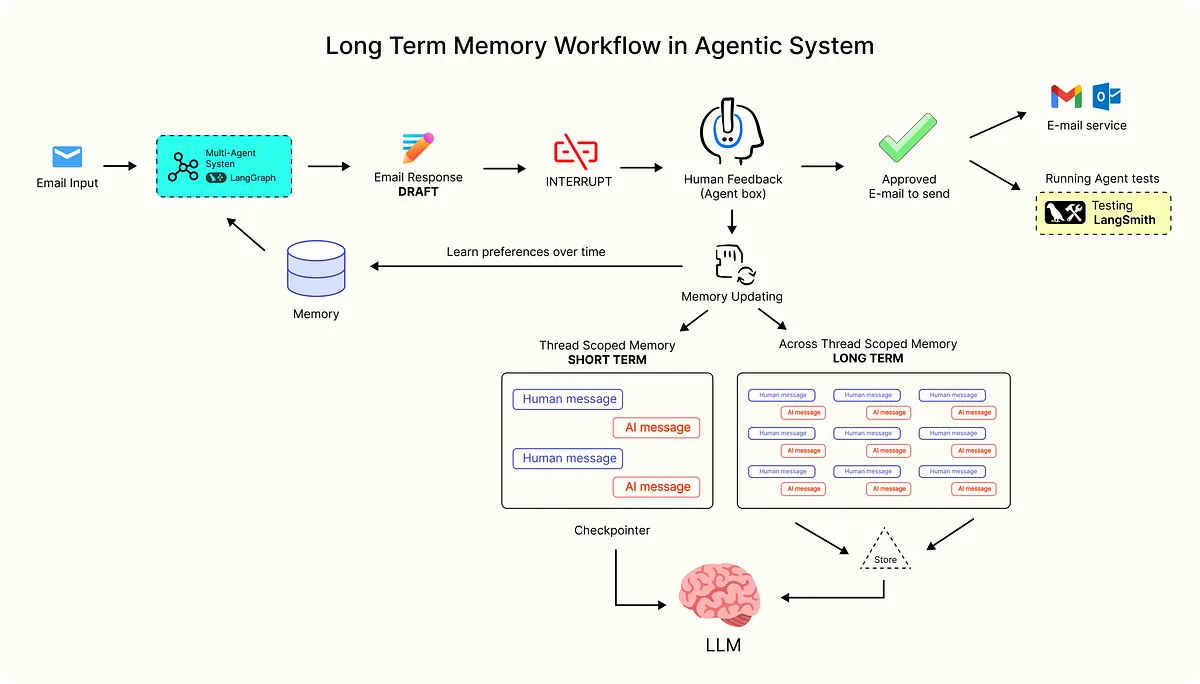
2. Run state
Run state records what a specific execution is doing: current step, inputs, tool results, retries, approvals, errors, and pending actions. It exists so a workflow can pause and resume safely.
LangGraph’s official documentation describes checkpoints at node boundaries and saved state for interrupts and recovery. Temporal similarly describes durable execution that resumes after crashes, network timeouts, or long waits. These are execution guarantees—not personal memory.
3. Durable memory
Durable memory stores selected cross-session information, such as a user preference, a project decision, or a recurring constraint. A memory service may extract and consolidate these records from interactions. AWS AgentCore, for example, distinguishes turn-level short-term memory from long-term records containing selected insights.
Because extraction uses models or rules, memories can be incomplete, stale, misattributed, or overgeneralized. Treat them as records with provenance and confidence, not as unquestionable truth.
4. Retrieval
Retrieval finds relevant material at request time: past chats, documents, database rows, or memory records. Retrieval does not itself mean the agent learned anything. It is a query over stored material, and its quality depends on indexing, filters, permissions, ranking, and freshness.
A persistent system often retrieves by both semantic similarity and structured boundaries such as tenant, project, record type, or effective date. Semantic similarity alone can surface a plausible but unauthorized or obsolete record.
5. Long-running tasks
A task lasting hours or days needs durable checkpoints, deadlines, idempotency keys, tool receipts, and approval state. It may not need personal memory at all. An invoice workflow can resume after a manager responds without storing the manager’s preferences for future conversations.
6. Learning
Learning means changing future behavior based on evidence. Saving a transcript is not learning. Saving a generated “lesson” is not validated learning either.
Operational learning should have a review loop: propose a rule or reusable procedure, test it against examples, approve a version, monitor its effect, and roll it back if quality drops. Letting an agent silently rewrite its own instructions turns isolated mistakes into persistent ones.
7. The system of record
The system of record is the authoritative source for current facts: a CRM for customer status, a ticketing system for ownership, a calendar for meetings, or a repository for released code. Agent memory should not override it.
If memory says a contract ends in June but the contract system says August, the current authoritative record must win. Memory can preserve context—“the customer asked about the old June date”—without becoming the source of truth.
ChatGPT and Claude are not simply “stateless”
Blanket claims that mainstream assistants forget every previous conversation are no longer accurate.
OpenAI’s current Memory documentation says available ChatGPT controls can include saved memories, reference to chat history, custom instructions, files, and connected-app content; availability varies by plan, region, platform, and workspace settings. It also explains that memory does not retain every detail, saved memories can be separate from chat history, and deleting a chat alone may not delete a saved memory.
Claude’s current help documentation describes both past-chat search and memory, with plan and organization controls, project boundaries, edit/delete controls, and incognito or memory-off modes. Its exact behavior and availability also depend on the product context.
Those features can provide cross-session personalization and retrieval. They do not automatically provide recoverable business workflows, exactly-once tool execution, authoritative records, or a complete audit trail. Product memory and durable agent orchestration solve overlapping but different problems.
A reference architecture for persistence
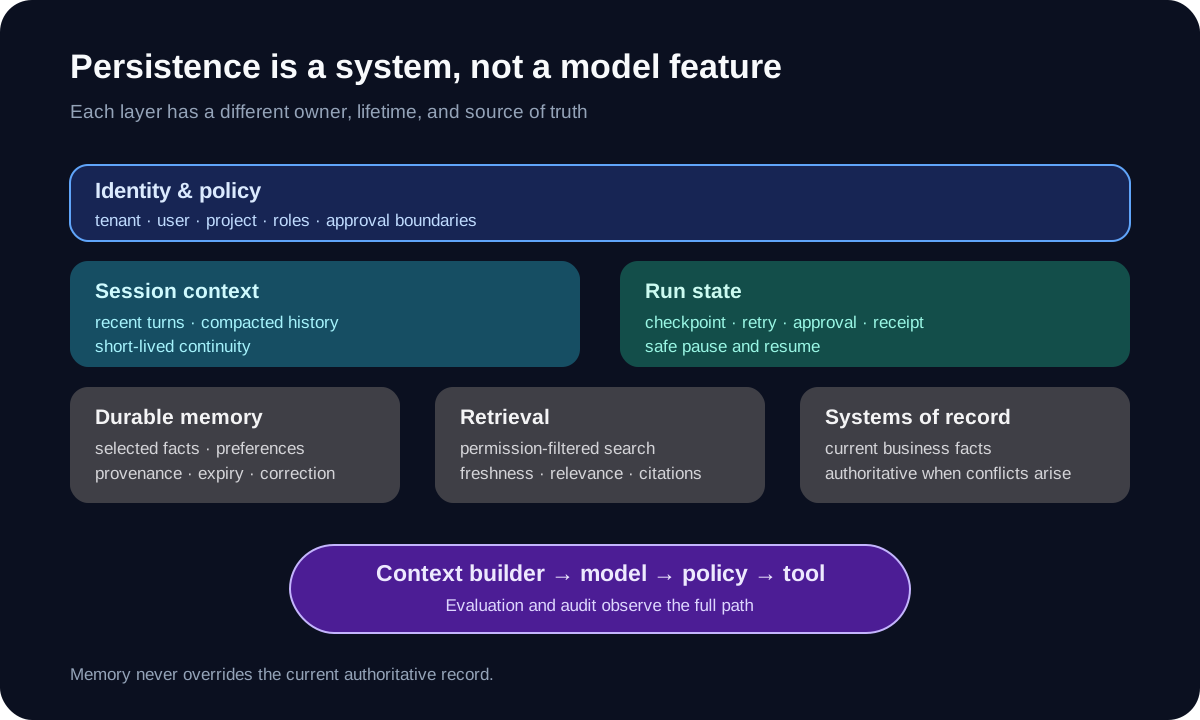
A production design can be understood as six cooperating stores and services:
| Layer | Stores or does | Key requirement |
|---|---|---|
| Identity and scope | user, tenant, project, roles | never retrieve across the wrong boundary |
| Conversation store | messages and attachments | retention, export, deletion, access control |
| Workflow state store | step, checkpoint, approval, retry, receipt | safe resume and idempotent side effects |
| Memory store | selected facts, preferences, episodes | provenance, expiry, correction, confidence |
| Knowledge and systems of record | documents and live business data | freshness and authoritative precedence |
| Evaluation and audit | traces, versions, outcomes, incidents | redaction, access, reproducible tests |
At each model call, a context builder assembles only what is needed: current instructions, bounded recent context, relevant approved memories, retrieved source material, and live facts. The model proposes a response or tool action. A policy layer validates authorization and requires approval where appropriate. The workflow engine then records the result and checkpoint.
Memory writing should be a separate decision. Not every message deserves long-term storage. A write policy can require a defined category, source link, owner, sensitivity label, retention period, and conflict rule.
Permission, retention, and deletion are part of the feature
Persistence increases the value of an agent and the consequences of getting access control wrong.
Scope every read and write
Use stable identifiers for tenant, user, project, task, and memory namespace. Apply authorization before retrieval, not after the model sees the result. Separate read tools from write tools, and use the narrowest scopes possible.
Do not treat a project name in a prompt as an authorization boundary. Enforcement belongs in the application and storage layer.
Define retention by data class
Conversation logs, workflow checkpoints, personal preferences, business facts, and audit records need different lifetimes. “Keep forever because it might help” is not a retention policy.
For each class, document why it exists, its default expiration, legal or contractual requirements, archive rules, and who can change the setting. Short-lived run state can often expire soon after completion; durable preferences may remain until changed; regulated audit evidence may follow a separate schedule.
Make deletion complete and testable
Deleting one chat may not remove derived memories, embeddings, exports, backups, traces, or copies in connected systems. A deletion workflow should locate the source and derivatives, revoke future retrieval, record completion, and explain any legally retained material.
Test deletion with a canary record: create it, allow it to propagate, delete it through the supported path, then verify that search, memory retrieval, exports, and ordinary responses no longer surface it.
How to evaluate a persistent agent
Evaluate both recall and restraint. A system that remembers everything relevant but also surfaces private or stale material is not good memory.
Build a versioned test set with these cases:
- correct recall across sessions;
- refusal to recall another user’s or project’s data;
- conflict between memory and the current system of record;
- correction of an outdated preference;
- deletion and expiration;
- irrelevant but semantically similar memories;
- interruption before and after an external side effect;
- duplicate event delivery;
- resumption after a model, worker, or network failure;
- malicious content in retrieved history or documents.
Measure retrieval precision, supported-answer rate, stale-memory rate, cross-boundary leakage, duplicate side effects, successful recovery, unnecessary escalations, deletion completion, latency, and cost. Inspect the whole trace: what was retrieved, what was excluded, which version ran, and why a tool action was allowed.
When persistent agents are useful
Persistence earns its complexity when work genuinely crosses sessions or waits:
- a case-management agent that pauses for documents and approvals;
- a research agent that keeps a sourced decision log across several days;
- an operations agent that resumes after rate limits without duplicating writes;
- a project assistant that recalls approved conventions and decisions;
- a support agent that retrieves prior cases while respecting account boundaries.
It is less suitable for one-off sensitive questions, simple deterministic transformations, tasks where old context is more dangerous than helpful, or situations without a reliable identity and deletion model. In those cases, a stateless session or temporary mode is a feature, not a limitation.
A deployment checklist
Before enabling persistence, answer these questions:
- Which state must survive a turn, session, restart, and deployment?
- Which store is authoritative for each fact?
- What identifiers and policies prevent cross-user or cross-project retrieval?
- What may be written automatically, and what needs review?
- How are conflicts, corrections, expiry, and deletion handled?
- Can a paused run resume without repeating a side effect?
- Can users and administrators inspect, export, and remove stored data?
- Do evaluations test not only recall, but also restraint and recovery?
- What is the fallback when a store, model, or tool is unavailable?
- Who owns incidents caused by wrong or stale memory?
For the operational difference between chat tools and working systems, see AI agents versus AI assistants. The guide to why AI forgets between sessions explains the context-window side of the problem, while real AI agent use cases helps decide whether persistence is worth adding.
The bottom line
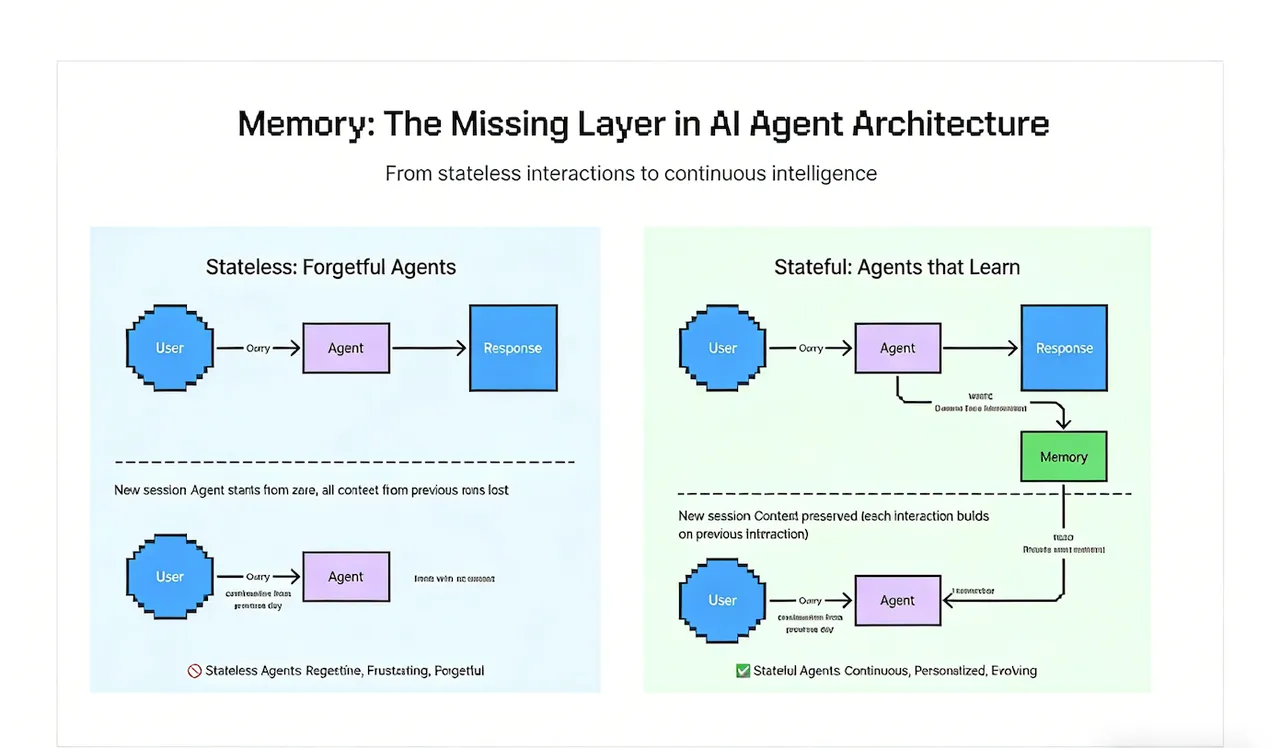
A persistent AI agent is not an LLM with an infinite memory. It is a stateful system that deliberately stores, retrieves, resumes, corrects, expires, and deletes information around a model.
The most important design choice is not how much the agent can remember. It is whether the system can distinguish conversation context from execution state, memory from retrieval, learned procedures from unreviewed guesses, and historical context from the current source of truth.
When those boundaries are explicit, persistence can reduce repeated explanations and support genuinely long-running work. When they are not, persistence simply makes errors last longer.
Original visual references
These images are restored from the article's original publication to preserve interface, workflow, and comparison context. Any product UI, pricing, benchmark result, or model availability shown is a historical capture; verify current official information before making a decision.
Official references
Related posts
DeepSeek DSH Superagent: From GitHub Requests to Agent Workflows
Understand how DeepSeek's DSH Superagent prototype turns authorized GitHub and Feishu requests into coding tasks, and which workflow…

What Is Gemini Agent? Google's Universal Work Agent Explained
Gemini Agent is Google's universal work agent for persistent tasks, multi-agent coordination, model routing, and work across business…
AI Agent Connectors Explained: MCP, OAuth, and Permissions
Learn how AI agent connectors use MCP, OAuth, scopes, resource permissions, and approval gates—and how to evaluate a connector before it…
https://floatboat.ai/blog/what-is-persistent-ai-agent