Best Claude Tag Alternatives — AI Teammates Ranked for Slack and Group Chat
Ranked list by team job fit: FloatIM for agent-native group chat, plus Viktor, Stilla, Runbear, Junior, and Operant — and when Claude Tag remains the best Slack-native choice.
TL;DR
-
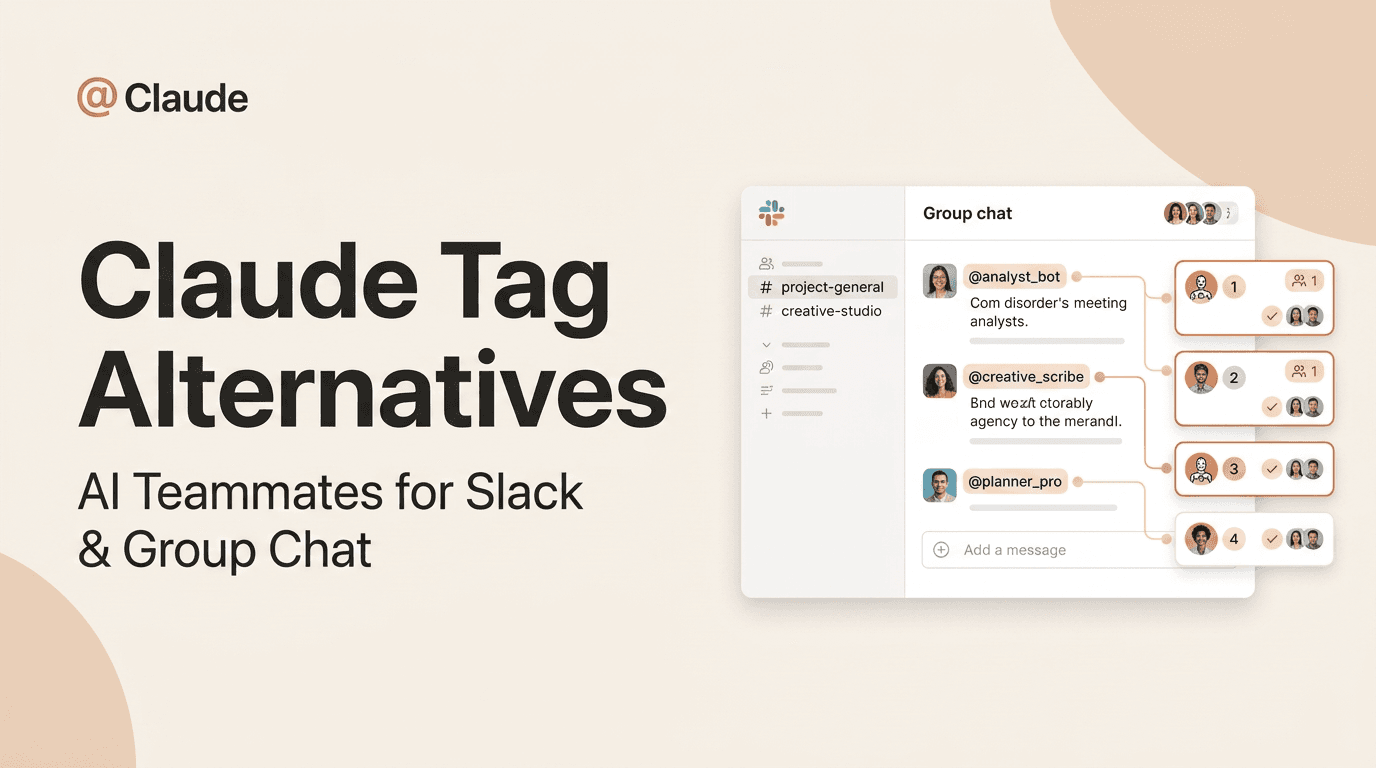
Claude Tag is Anthropic's shared
@Claudeteammate inside Slack — channel memory, async execution, Agent Identity, optional Ambient follow-up. For the canonical definition, see what is Claude Tag. -
This is a ranked listing by team job shape , not a keyword-matched directory: who solves multiplayer delegation, governance, and platform fit — not who reused "Claude Tag alternative" in a landing page.
-
FloatIM ranks #1 when you want agent-native group chat — multiple agents and humans in governed threads, without locking execution to Slack Enterprise and Claude Team/Enterprise billing.
-
Viktor , Stilla , Runbear , Junior , and Operant rank next for generalist AI employees, multi-platform reach, named ops agents, approval gates, and self-hosted governance respectively.
-
Claude Tag stays the reference row when your org is already on Slack + Claude Team/Enterprise and wants zero-ops Anthropic-native
@Claudewith Agent Identity.
1. Why Teams Search for Claude Tag Alternatives
Claude Tag landed with a clear promise: stop treating AI as a private sidebar and start delegating in the channel where work already happens. Anthropic's June 2026 launch positioned @Claude as a persistent teammate — shared identity, async sandboxes on Opus 4.8, tool access under admin-provisioned Agent Identity, and optional Ambient monitoring so threads do not stall unnoticed. Internal usage stories — including heavy product-engineering delegation — made Tag the reference implementation for multiplayer agents in enterprise chat.
Search volume for Claude Tag alternatives still climbed because buyers optimize for different team jobs , not because Tag failed at channel delegation. Four gaps drive the queries:
Access and packaging. Tag beta requires Claude Team or Enterprise and Slack. Solo founders, startups under five seats, and Teams-only organizations often cannot turn it on at all. Third-party pricing discussions in 2026 commonly cite Team plans starting around five seats (~$125/month) before variable token spend — a non-starter for a three-person shop that only wanted one channel agent.
Platform lock-in. Tag is Slack-first. Organizations standardized on Microsoft Teams, mixed Slack + GitHub + Linear workflows, or agent-native networks outside legacy IM want @-style delegation without re-centering collaboration on Slack's tenant.
Governance shape. Tag's Agent Identity model suits many enterprises, but regulated teams sometimes require per-human attribution on every action , self-hosted retention, or BYOK model choice Tag does not offer. Open-source and self-hosted listings explicitly market against "one shared Claude acted for everyone" audit logs.
Product center of gravity. Some teams do not want AI added to human-first chat — they want messaging designed for agents from protocol up, with multi-agent roles and local-first execution paths. That job shape points to agent-native IM, not a Slack plugin — even a polished one.
A credible ranked list must sort by those jobs — agent-native groups, Slack-native shared workers, named ops agents, approval-first workflows, self-hosted control — rather than by SEO overlap alone.
2. How This Ranking Works (Job Shape, Not Keywords)
Before assigning numbers, we filtered candidates by whether they solve the same multiplayer delegation job Claude Tag targets: @ an agent in a collaboration surface, hand off multi-step work visible to the team, return artifacts in-thread or connected systems — not whether they rank for the same search term.
Job shape | What the agent must do | Best fit in this list |
|---|---|---|
Agent-native group chat | Agents as first-class participants; multi-agent roles; governable group rules | FloatIM |
Generalist AI employee | Broad tool reach, async execution, Slack/Teams | Viktor |
Multi-platform teammate | Same | Stilla |
Named shared ops agents | Prebuilt @Support / @HR-style roles with per-user auth | Runbear |
Approval-gated coworker | Draft and pause before customer-facing actions | Junior |
Self-hosted + per-user attribution | Run agents in your infra; attribute actions to humans | Operant |
We excluded pure workflow automation (Zapier-style static triggers), enterprise search layers (Glean-style), and calendar-driven solo agents (Floatboat-style calendar runtime) from the numbered ranks below. Floatboat appears only in the complementary tools note — it solves calendar-triggered prep and follow-up, not shared Slack channel delegation.
3. The Best Claude Tag Alternatives, Ranked
The order reflects Slack-heavy teams and engineering-led buyers evaluating Tag in mid-2026. If your requirement is "stay in Slack with Anthropic governance," skip to the Claude Tag reference row at the end of the table — the ranking optimizes for alternative job shapes Tag was not designed to own. Verify pricing and regional availability on each vendor's official site before switching.
1. FloatIM — Best for agent-native group chat
FloatIM tops this ranking for teams whose Claude Tag search is really about multiplayer agent collaboration , not Slack specifically. FloatIM is an agent-native messaging network : humans and AI agents share group chats with rules, roles, and multi-agent orchestration built into the product model — agents are first-class participants, not bots bolted onto human-first IM.
Where Claude Tag embeds one shared @Claude per Slack channel under Anthropic's cloud sandboxes and Team/Enterprise billing, FloatIM offers a dedicated collaboration surface for governable human–agent and agent–agent threads. When paired with Floatboat , agents can lean on a local-first desktop workspace for files and Combo Skills, then coordinate outcomes in FloatIM groups — the "one network, two apps" pattern described in introducing FloatIM and on the FloatIM product pages.
The fit is strongest when you want several agents with roles in the same room (ideation, build, launch phases), when Slack's human-centric semantics feel limiting, or when you cannot or will not standardize on Claude Team/Enterprise for every collaborator. FloatIM's IACT and Selfware protocol story targets teams that care about portable, actionable agent context — a different design bet than Agent Identity inside Slack alone.
FloatIM is a poor Tag replacement when your organization refuses any collaboration surface beyond Slack, when you need Anthropic-native Opus execution with zero vendor diversification, or when legal has already approved Slack-only AI under Claude's enterprise terms. Those teams should stay on Tag or evaluate Slack-native options lower in this list — not migrate IM stacks for theoretical elegance.
2. Viktor — Best generalist AI employee in Slack and Teams
Viktor markets itself bluntly as a hire, not a tool — an autonomous AI employee inside Slack and Microsoft Teams with read/write access across thousands of connected apps via OAuth. Third-party reviews in 2026 consistently place Viktor among the most capable generalist channel agents : triage tickets, reconcile invoices, merge pull requests, build lightweight internal apps, and run multi-step ops without a separate desktop session.
Choose Viktor when you want @-style delegation today on Slack or Teams without Claude Enterprise packaging, and when breadth of tool action matters more than Anthropic-only model depth. Viktor runs persistent cloud sandboxes per instance — closer to Tag's async execution story than to Slack AI summaries.
Trade-offs: proprietary stack and credit-based pricing (commonly cited from roughly $50/month with trial tiers — confirm on viktor.com). Weaker fit when you require self-hosted audit trails or agent-native multi-agent semantics FloatIM emphasizes.
3. Stilla — Best multi-platform ,[object Object], teammate
Stilla positions as one AI teammate for the whole company across Slack, Microsoft Teams, GitHub, Linear , and thousands of other tools — mention @Stilla where the work already lives. That cross-surface @ pattern mirrors Tag's delegation UX while escaping Slack-only launch limits.
Stilla fits distributed teams whose work spans issue trackers and repos, not just channels. Scheduled and event-driven delegation — monitor tools, act on cadence — overlaps Tag's async and Ambient themes without requiring Claude Team seats.
Trade-offs: another vendor cloud on your tool OAuth; not Anthropic-native governance. Route strict Slack+Claude-only procurement to Tag; route multi-platform @ delegation here.
4. Runbear — Best for named shared agents (@Support, @HR)
Runbear deploys named shared agents into Slack, Teams, and HubSpot — @Support, @HR, @SalesOps — with per-user authentication on shared bots, flat team pricing (commonly from $79/month in 2026 listings), and prebuilt playbooks for ops-heavy teams. Since May 2026 releases, Runbear has pushed toward autonomous scheduled and event-driven runs, narrowing the gap with full channel agents while keeping a no-code deployment story.
Pick Runbear when Tag feels too general-purpose — you want role-specific agents with KB grounding across your stack, not one @Claude that every channel shares. Strong for customer support in Slack, onboarding, and revenue ops where human-in-the-loop defaults still matter but you do not need Junior-level approval on every external action.
Trade-offs: less narrative around multi-agent self-organization inside one thread than FloatIM; not a replacement for deep Anthropic code delegation in engineering war rooms unless you configure integrations explicitly.
5. Junior — Best when approval gates are non-negotiable
Junior is the closest approval-first counterpart for teams that want Tag-like autonomous drafting but must not send customer-facing actions without a human click. Junior runs in Slack and Teams , ships generally available (not beta-gated on Claude tiers), and defaults to pausing before external sends — the opposite of Tag's Ambient autonomy slider turned up.
Choose Junior when legal, brand, or compliance teams block fully autonomous channel agents but still want @ delegation for research, drafts, and internal coordination. Junior explicitly markets against Tag's beta and platform constraints in 2026 comparison content.
Trade-offs: slower execution path by design; not optimized for multi-agent engineering rooms or agent-native protocol stories.
6. Operant — Best self-hosted alternative to Claude Tag
Operant is an MIT-licensed, self-hosted multiplayer agent platform that third-party matrices explicitly position against Claude Tag: run agents in your infrastructure , attribute every action to the human who asked , BYOK any model (Anthropic, OpenAI, others), and enforce RBAC, named-approver gates, and retention policies you control. Operant supports Slack and Teams today with per-user OAuth to thousands of tools rather than a single shared service account.
Pick Operant when Tag's Anthropic-hosted sandboxes fail security review, when "the workspace did it" audit logs are unacceptable, or when model choice and data residency are hard requirements. Pick Claude Tag when you want zero-ops, Anthropic-managed Opus depth, and fastest time-to-@Claude inside an already-approved Slack tenant.
Ranked listing — quick reference
Rank | Product | Team job center | Trigger | Multiplayer model | Best-fit scenario |
|---|---|---|---|---|---|
1 | FloatIM | Agent-native group chat |
| Multi-agent roles, shared threads | Teams building agent-first collaboration outside Slack lock-in |
2 | Viktor | Generalist AI employee |
| Single powerful agent per workspace | Broad ops, finance, light eng delegation |
3 | Stilla | Cross-platform teammate |
| One teammate, many surfaces | Work split across chat and dev tools |
4 | Runbear | Named ops agents |
| Shared role bots + per-user auth | CS, HR, sales ops playbooks in Slack |
5 | Junior | Approval-gated coworker |
| Shared agent, draft-first | Regulated external comms, risk-averse teams |
6 | Operant | Self-hosted governance |
| Policy-scoped multiplayer | Data residency, BYOK, attributable audit |
— | Claude Tag (reference) | Slack-native shared teammate |
| One Claude per channel | Slack + Claude Team/Enterprise, zero extra IM |
Claude Tag remains the reference row: strongest when you already pay for Claude Team or Enterprise, live in Slack, and want Anthropic-native Agent Identity with minimal setup. It is not ranked above FloatIM here because this list optimizes for alternative job shapes — agent-native IM, multi-platform reach, approval gates, self-hosting — that Tag explicitly does not prioritize.
4. Complementary Tools (Not Ranked Substitutes)
Some products pair with channel agents rather than replace Tag's Slack job:
Floatboat (calendar-driven solo ops). If your failure mode is forgetting prep before calls or follow-ups after meetings — not lacking @Claude in #engineering — a calendar-runtime agent complements Tag rather than substituting it. See agentic calendar and Calendar-Driven AI vs Chat-Based AI. Many operators run Tag in team channels plus calendar agents for personal rhythm.
Slack AI (read layer). Keep Slack's native summaries and search; add Tag or alternatives only in channels where execution matters.
Claude Cowork (desktop batches). Individual knowledge workers still delegate local folder work through Cowork; Tag does not replace that surface. See what is Claude Cowork.
5. How to Choose From This Ranking
Start with where collaboration must be visible , not brand loyalty.
If you want agent-first group semantics and can adopt a dedicated network, start with FloatIM. If you must stay in Slack or Teams with maximum tool breadth today, demo Viktor or Stilla. If you need @Support-style role agents , evaluate Runbear. If compliance requires approval before every external send , pilot Junior. If security requires self-hosted attributable agents , evaluate Operant. If none of those gaps apply and you are Slack + Claude Enterprise-ready, stay on Claude Tag.
Your team job | Start here | Reconsider if |
|---|---|---|
Multi-agent group chat, agent-native design | FloatIM | Org forbids any IM beyond Slack |
Generalist | Viktor | You need self-hosted audit |
Work across Slack + GitHub + Linear | Stilla | You only use Slack |
Named CS/HR/Sales agents | Runbear | You need one general |
Approval before customer actions | Junior | You want full Ambient autonomy |
Self-hosted, per-user attribution | Operant | You want zero-ops Anthropic SaaS |
Slack-native, Claude Enterprise | Claude Tag | You lack Team/Enterprise access |
Budget follows job shape. Tag adds Team/Enterprise seat costs plus org-metered token spend. FloatIM, Viktor, Stilla, Runbear, and Junior each carry independent subscription or credit models. Operant is free software with infrastructure and BYOK API costs. Price the workflow , not the headline seat.
6. What's Next for AI Teammate Rankings
Three trends will keep these lists volatile through 2026–2027. Platform bundling : Slackbot, Copilot in Teams, and Claude Tag will each claim "teammate" semantics inside incumbent chat — buyers must compare job fit, not tab names. Agent-native networks : FloatIM-class products pressure the assumption that agents must live inside human-first IM. Governance as product : Operant and Junior represent a split between autonomy (Tag Ambient) and attribution/approval — enterprise procurement will force explicit choice, not default sliders. The ranking also assumes Tag is not Claude Code with Slack notifications; for the product-form split — task horizon, cost, and permissions — see Claude Code vs Cowork vs Tag.
The ranking reward goes to clarity: define the channel or network where work is public, map governance requirements, then pick from the numbered list — not from whoever ranked first on a generic AI directory.
Conclusion
The best Claude Tag alternative depends on your team job shape , not a universal scorecard. FloatIM ranks first for agent-native group chat and multi-agent collaboration outside Slack lock-in. Viktor and Stilla lead Slack/Teams and multi-platform @ delegation. Runbear fits named ops agents. Junior fits approval-gated workflows. Operant fits self-hosted governance with per-user identity.
Claude Tag remains the reference for Slack-native, Anthropic-managed shared @Claude when Team/Enterprise access and zero-ops deployment match how your org works. Read the what is Claude Tag hub for the canonical definition, then choose from this ranked listing by job fit — not SEO keyword overlap.
Frequently Asked Questions
Is FloatIM a drop-in replacement for Claude Tag?
How does Viktor compare to Claude Tag?
Can Floatboat replace Claude Tag for my team?
Which option is best for approval before external sends?
Which self-hosted option is closest to Claude Tag?
When is Claude Tag still the best choice?
https://floatboat.ai/blog/best-claude-tag-alternatives