
Effort Control and Fast Mode for AI Work
A practical framework for choosing AI reasoning effort and response speed by task risk, latency, cost, and review burden.
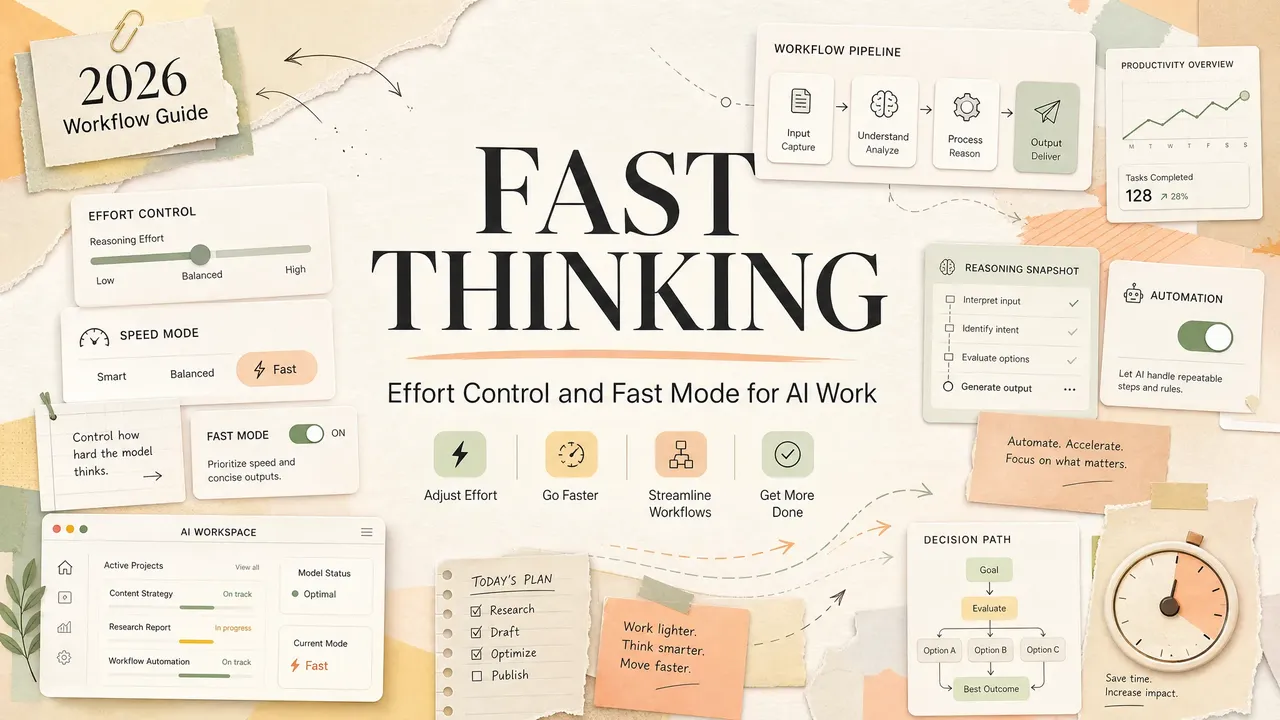
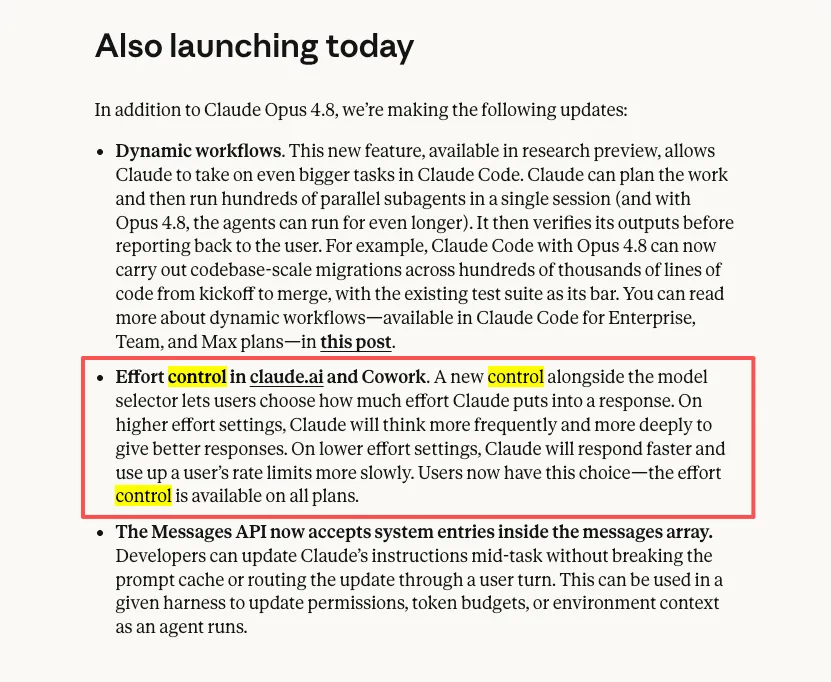
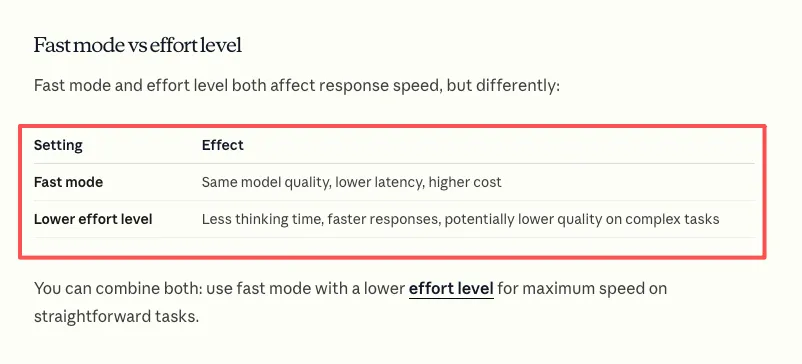
AI work now has two separate speed controls. Effort changes how much reasoning the model applies; Fast Mode changes how quickly a supported model serves its output. Lowering effort may make a task cheaper and quicker by asking for less analysis. Fast Mode can return the same model class faster, but at premium pricing.
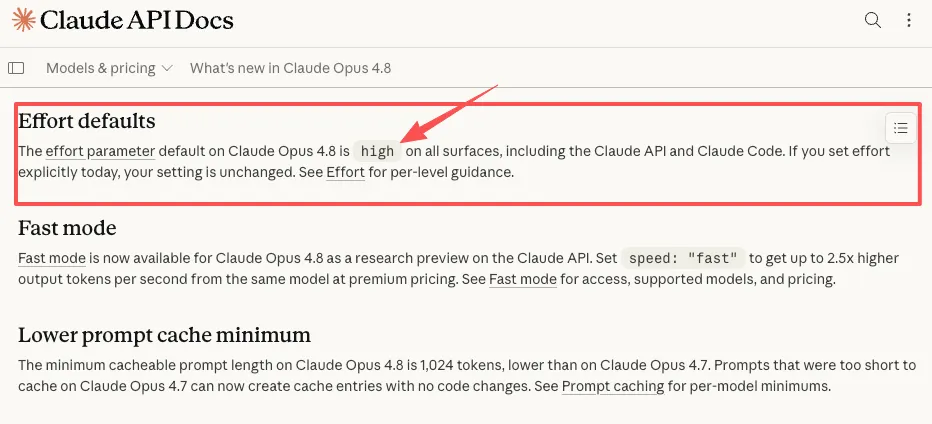
As of October 13, 2026, Anthropic documents effort levels from low through max on supported models and describes Fast Mode as a research preview on selected Opus models. Its model-selection guide says Fast Mode can deliver up to 2.5× higher output speed at a premium; availability still depends on model, platform, account access, and current documentation. This is a workload-selection framework, not a claim that one setting always wins.
Effort and speed are independent decisions
| Task condition | Effort starting point | Speed starting point | Why |
|---|---|---|---|
| Low consequence, repeated, easy to review | Low or medium | Standard | Avoid paying for analysis the task does not use |
| Low consequence, latency blocks a person | Low or medium | Fast, if available | Responsiveness has direct workflow value |
| High consequence, clear evidence and rubric | High or xhigh | Standard | Reasoning quality matters more than instant output |
| High consequence and time-critical | High or xhigh | Fast, then human review | Buy latency only when delay is genuinely costly |
“Important” is too broad. A client email can be important but cognitively simple. A reversible internal taxonomy decision can require substantial reasoning. Choose effort by ambiguity and consequence; choose speed by the cost of waiting.
What the effort setting changes
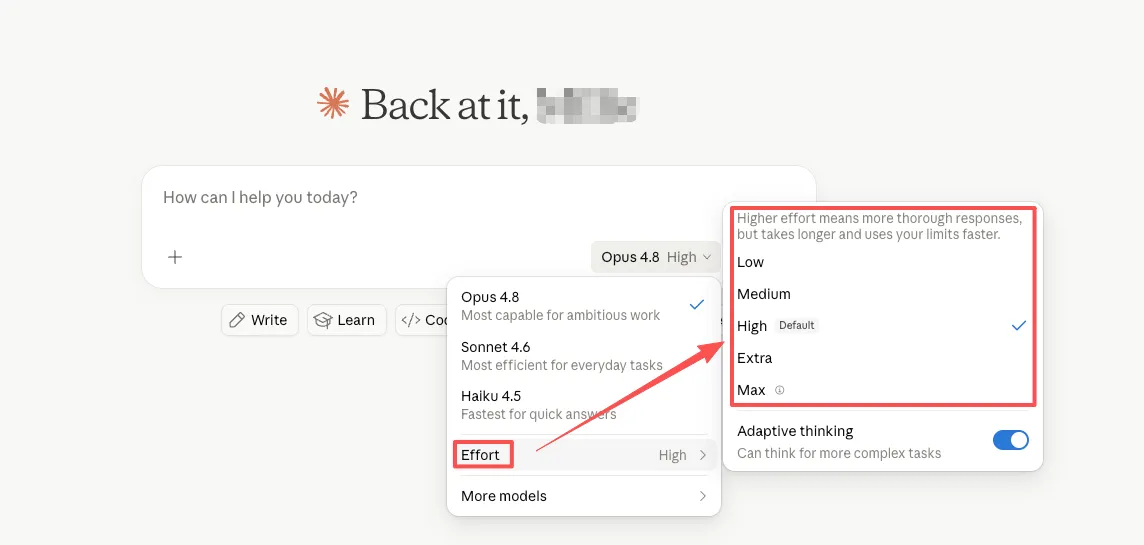
Anthropic’s prompting guidance explains that adaptive-thinking models calibrate reasoning from both effort and query complexity. Higher effort can produce more thorough analysis, but can also increase latency and token use. It does not repair missing evidence, unclear instructions, or unsafe tool permissions.
Use low for extraction, formatting, classification, or transformations with deterministic checks. Start at medium for ordinary drafting and comparison. Reserve high, xhigh, or max for competing constraints, multi-step plans, difficult diagnosis, or expensive mistakes. Not every model supports every level, so verify the model page before standardizing a workflow.
Effort is useful only when the task has an acceptance test. “Think harder about this strategy” gives the model more room but no clearer target. “Rank these options against cash risk, reversibility, and a 30-day implementation constraint” makes additional reasoning inspectable.
When Fast Mode is worth paying for
Fast Mode is a serving-speed decision, not a quality shortcut. Anthropic’s release notes describe faster output generation at premium pricing and show support expanding model by model. Check current pricing and access before building it into a customer promise.
It is easiest to justify when latency sits on the critical path:
- a person is waiting during an interactive debugging or editing loop;
- a support operator needs a draft while the customer is present;
- several agent steps are sequential, so slow responses compound;
- a deadline has a measurable business cost.
It is harder to justify for overnight research, batch classification, scheduled reports, or work already waiting in a review queue. Faster generation creates no value if the result remains unread for six hours.
A routing method that survives model updates
Do not route by content label alone. “Research” can mean a five-minute source list or an acquisition decision. Ask four questions:
- How expensive is a wrong answer? Include rework, reputation, money, and access risk.
- How hard is the output to verify? A JSON schema is cheap to check; a forecast is not.
- Is waiting blocking a person or dependent step? If not, speed has little marginal value.
- Can the task be decomposed? Cheap stages can prepare evidence before a high-effort decision stage.
A content workflow might use low effort to normalize notes, medium to generate an outline, high to resolve contradictory sources, and standard speed for an overnight final draft. The same staged design appears in a robust AI agent workflow for vibe coding: spend intelligence at uncertain gates, not on every mechanical step.
Measure accepted output, not impressive output
Build a small evaluation set from 10–20 representative tasks. For each setting, record total time to an accepted result, input and output cost, corrections, factual or constraint failures, reviewer minutes, and whether the result was used.
Do not compare only first-token latency or benchmarks. A fast draft that needs fifteen minutes of repair can lose to a slower draft accepted immediately. Maximum effort that adds polish nobody values is also waste.
Change one variable at a time. First compare effort levels at standard speed. Then test Fast Mode on the winning effort level. That separates a reasoning-quality effect from a serving-speed effect.
Failure modes to avoid
Maximum effort by default. Escalate only after a lower setting fails a named acceptance criterion.
Fast Mode as an urgency badge. “ASAP” does not prove latency is the bottleneck. Find the next dependent action and its deadline.
Using effort to compensate for weak evidence. No setting can validate an unsourced claim. Supply primary sources and require citations.
Ignoring review capacity. Higher throughput can overwhelm approval. Tune generation and review rates together.
Hard-coding one vendor feature. Keep routing rules in task language—low-risk extraction, high-risk synthesis, latency-critical interaction—so the workflow remains portable. The solo-founder AI workflow guide explains how to design those reusable stages.
Original visual references
These images are restored from the article's original publication to preserve interface, workflow, and comparison context. Any product UI, pricing, benchmark result, or model availability shown is a historical capture; verify current official information before making a decision.
A practical default
Start routine, reversible work at medium effort and standard speed. Move effort down when acceptance remains stable; move it up when a documented failure requires deeper reasoning. Enable Fast Mode only where waiting blocks a person or dependent action, then compare its premium with the time actually saved.
The goal is not to make the model think as much or speak as fast as possible. It is to spend reasoning and latency where they change the accepted result.
Related posts

OpenAI GPT-6 Cyber: Who Gets Access and What It Can Do
OpenAI’s GPT-6 Cyber starts with a limited Daybreak Red rollout. Check eligibility, Codex and API access, and token pricing, then see how…

GPT-6.1 Sol: Pricing, Benchmarks, Availability, and How It Compares
GPT-6.1 Sol brings near-Astra coding, computer use, and professional-work performance at one-fifth of Astra's token prices. Here is what…

What Is Jev? The AI Model That Never Writes Text
Jev is TypeSafe AI's System One model: typed probabilistic decisions instead of generated text, claimed 193.6x faster and 444.6x cheaper.…
https://floatboat.ai/blog/effort-control-fast-mode-ai-work