Grok 4.6 — Agentic Frontier Model, Benchmarks, Reality Check
Grok 4.6 explained: 500K context, $2/$6 pricing, the 200K token price trap, benchmark claims vs independent scores, and where it fits next to DeepSeek V4 Pro.
TL;DR
-
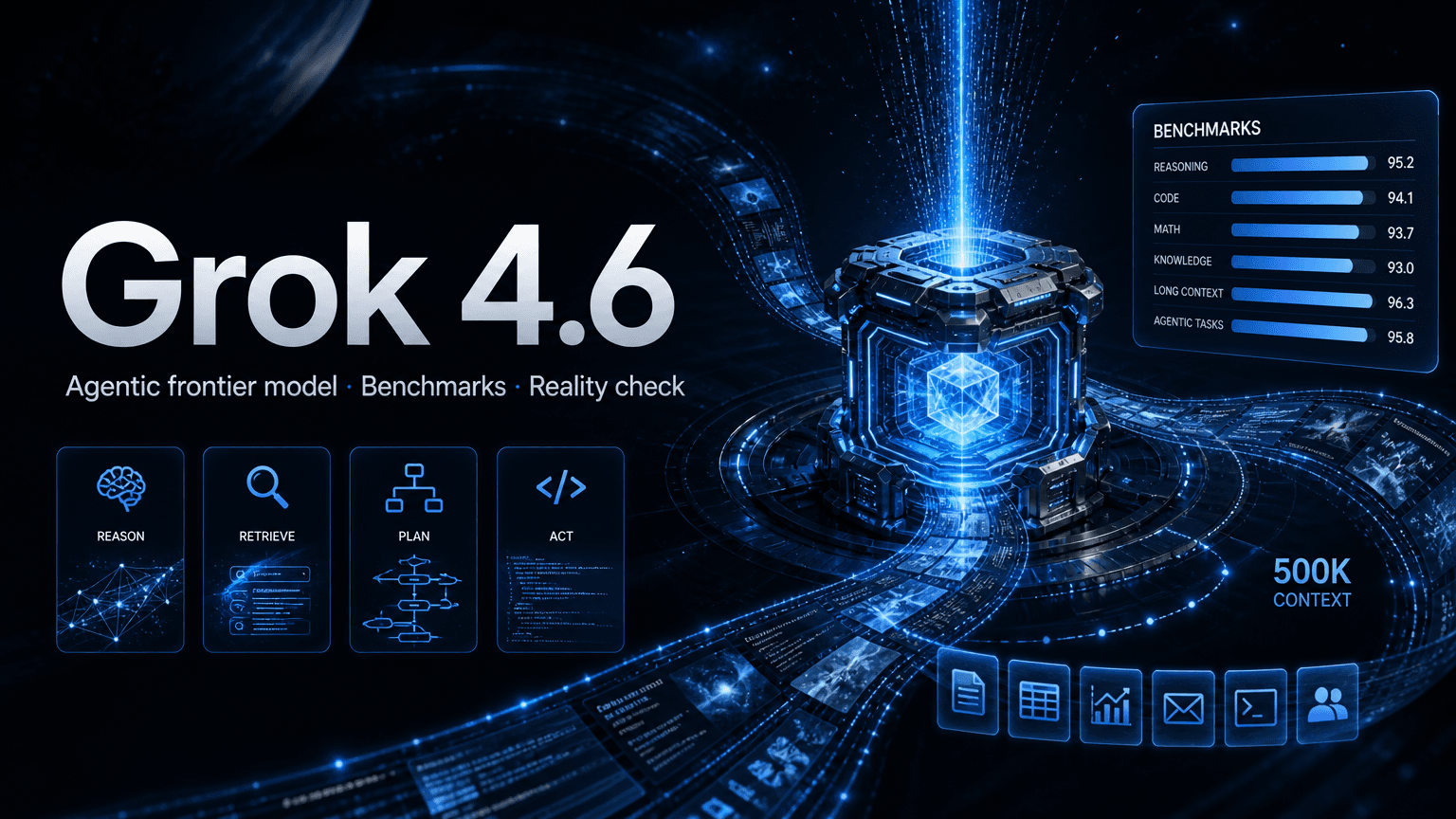
Grok 4.6 is xAI's August 12, 2026 release — a post-training upgrade on Grok 4.5, not a new architecture, focused on long-running agents, coding, and knowledge work, with a 500,000-token context window.
-
It matches GPT-5.6 Sol on the Artificial Analysis Intelligence Index (61 points), trailing only Claude Opus 5 and Claude Fable 5 — and it holds Grok 4.5's $2 input / $6 output per 1M token price, with a faster variant at 2x.
-
The headline price is incomplete: prompts at or above 200,000 tokens double to $4 / $12 per 1M tokens for the entire request, which rewrites the economics of genuinely long-context agent work.
-
Its strongest independent scores are in agentic knowledge work — GDPval-AA v2 Elo 1753, just behind Claude Opus 5 — while its software-engineering results are mixed, with benchmark-version confusion inflating some comparisons.
-
Grok 4.6 shipped the same week as DeepSeek's V4 Pro 0813 GA, giving buyers a rare same-week head-to-head between two agent-focused frontier models at budget prices.
1. What Grok 4.6 Is and Isn't
Grok 4.6 is a point release over Grok 4.5, and xAI was explicit about the strategy: hold the foundation model constant and spend the improvement on a longer training run, regenerated supervised fine-tuning trajectories, and reinforcement learning in agentic environments. The result is a model tuned to stay on task across many steps — researching a topic, working across a codebase, or turning an idea into a polished artifact — rather than a model that answers harder single-turn questions. That is a different bet from a scale-up release, and it shows up directly in where the model does and does not lead.
What Grok 4.6 is not is an open-weight model. Unlike DeepSeek's V4 line, which ships MIT-licensed weights, Grok 4.6 has no weights release and no self-hosting path — it is available through the xAI API, Grok Build, Cursor, and partners like OpenRouter, Vercel, and Cloudflare. For a solo founder that distinction matters as much as the benchmark table, because it determines whether your agentic workflow can move off a vendor's API if prices change or the product direction shifts.
The release also came with a deliberate access strategy: Grok 4.6 is live in Cursor and Grok Build immediately, with 2x included usage for the first week. The Cursor placement is notable — it is xAI's clearest signal yet that coding-agent workloads, not just chat, are the arena it is competing in. The same week DeepSeek slipped its V4 Pro GA into production, xAI held a formal launch for a model aimed at the same jobs, which makes the two releases a natural pair to evaluate together.
2. Specs, Context, and the 200K Price Trap
The technical sheet for Grok 4.6 looks strong on paper: a 500,000-token context window, text and image input with text output and no stated output limit, and a reasoning-effort ladder that now runs low / medium / high (default) / xhigh. The API model ID is grok-4.6, with rate limits of 150 requests per second and 50 million tokens per minute. xAI has not published a parameter count, and the knowledge cutoff is February 1, 2026 — worth knowing if you use the model for current-event research.
The pricing table is where most coverage has been incomplete. xAI's headline — $2 per 1M input tokens, $6 per 1M output — applies only to prompts under 200,000 tokens. Once a request reaches that threshold, the rate for the entire request doubles to $4 input / $12 output, and cached input rises from $0.50 to $1.00 per 1M tokens. The doubling applies to all tokens in the request, not just those over the line, so a 200K prompt costs the same per-token as a 500K prompt — there is no "cheap first 200K" band.
That structure has a direct implication for agentic work, where long context is the point. A coding agent that keeps a large repository's contents in context, or a research agent that accumulates documents across a session, can cross 200K tokens quickly. When it does, the effective cost of the session jumps 2x, and the "cheap frontier model" framing collapses toward premium pricing. The practical mitigation is exactly what xAI's own docs recommend: set a prompt_cache_key so repeated context is served from cache at $0.50–$1.00 per 1M tokens, which is a 75% discount on cached input and matters enormously for multi-turn loops.
The reasoning-effort ladder deserves a closer look as a cost lever. With low, medium, high, and xhigh available on the reasoning_effort parameter, xAI has given developers a knob that works like DeepSeek's expanded effort settings on V4: use low for routine extraction and formatting, medium for typical agent steps, high (the default) for planning and debugging, and reserve xhigh for the hardest problems. Because token consumption scales with effort level, the dial is effectively a price selector in disguise — a habit of running everything at xhigh silently converts a budget model into a premium-priced one. Teams that route effort levels by task type report keeping effective per-task cost at or below the short-context headline rates.
There is also a deployment consideration that rarely appears in launch coverage: rate limits. Grok 4.6's API is capped at 150 requests per second and 50 million tokens per minute, with availability in us-east-1 and us-west-2. For a solo operator running one or two agent loops that is generous headroom. For a team parallelizing a burst of long-context jobs, the token-per-minute ceiling becomes the practical constraint before the price does — and the 200K threshold then interacts with that ceiling, since crossing into the long-context band doubles the tokens you can bill through in the same minute. Budgeting a burst means planning for both limits at once.
3. Benchmarks: What the Numbers Say
The cleanest way to read Grok 4.6 is through independent evaluation, because the launch materials present numbers on two different benchmark versions that are easy to conflate. On the Artificial Analysis Intelligence Index — a composite of nine benchmarks — Grok 4.6 scores 61, matching GPT-5.6 Sol Max and trailing Claude Opus 5 (63) and Claude Fable 5 (62). Independent measurement verified the claim at 60.92, ranking fourth of twenty models. That is a real frontier placement: the model's strongest results are on agentic knowledge work rather than static reasoning.
The per-benchmark picture is more granular. On GDPval-AA v2, Artificial Analysis's measure of real-world agentic knowledge work, Grok 4.6 posts an Elo of 1753 — behind only Claude Opus 5 and statistically indistinguishable from Claude Fable 5. On AA-Briefcase, a long-horizon agentic knowledge benchmark, it lands at Elo 1577, in Fable 5 territory. On terminal-based software tasks (Terminal-Bench v2.1), it scores 88.4%, level with the leaders. The one place the launch table is genuinely misleading is the coding-engineering side: xAI's own chart shows Grok 4.6 at 26% on Terminal-Bench v3.0 (a harder version) and 65.9% on DeepSWE v1.1, while GPT-5.6 Sol leads both — and a different 88.4% figure on v2.1 has been circulating as if it were the same test. Different benchmark versions, not comparable; the model is strong on agentic knowledge work, mid-pack on the hardest software-engineering evals.
The pattern across these numbers tells a coherent story about what xAI optimized. Grok 4.5's weakness was consistency over long horizons — it could start strong on a task and drift before finishing. Grok 4.6's training emphasis on agentic environments is aimed squarely at that failure mode, and the benchmarks that improved most are the ones that punish drift: AA-Briefcase, GDPval, and τ³-Banking all reward completing a multi-step task in order rather than producing a good single answer. The trade-off is visible in the same table — pure reasoning and the hardest coding evals did not move the same way, which is consistent with a post-training run that traded some breadth for reliability on sustained work.
4. Where Grok 4.6 Wins and Loses
The win column for Grok 4.6 is concentrated in agentic knowledge work and long-horizon interactive tasks. Beyond the GDPval and AA-Briefcase scores, it leads the field on customer-service-style tool use (τ³-Banking at 50.7%, top two) and shows the largest single gain of any model on legal reasoning benchmarks (Harvey LAB at 15.8%, up from 12.9% on Grok 4.5, versus GPT-5.6 Sol's 2.5%). On visual and interactive work — producing polished front-end artifacts from a single prompt — xAI says the model produces stronger first attempts than its predecessor, and independent reviewers report the "obviously synthetic" look that used to plague AI front-ends has largely disappeared.
The loss column is software engineering depth. DeepSWE v1.1 at 65.9% trails GPT-5.6 Sol's 73% and Fable 5's 70%; Terminal-Bench v3.0 at 26% trails GPT-5.6 Sol's 34.6%. If your workload is terminal-heavy or repo-scale refactoring, Grok 4.6 is not the leader. The model also sits mid-table on some vibe-coding and web-development leaderboards. For context on how this compares to another model whose multimodal focus is video generation rather than agents, our MiniMax H3 explainer covers the neighboring territory — but for agentic work, the two are not substitutes.
5. Grok 4.6 vs DeepSeek V4 Pro 0813
The same-week pairing with DeepSeek's V4 Pro 0813 is the most useful comparison available this month, because the two models target the same workloads with the same price philosophy. Grok 4.6 lists at $2 / $6 per 1M tokens; V4 Pro is at $0.435 / $0.87 — about a quarter of Grok's input rate and a seventh of its output rate, though both are an order of magnitude below the premium closed tier. Both are post-training upgrades aimed at long-running agents, and both arrived within 24 hours of each other in mid-August.
Where they differ is in what they optimize. Grok 4.6 wins on agentic knowledge work and on the raw composite — its Intelligence Index of 61 matches GPT-5.6 Sol, while V4 Pro 0813's independent composite sat at 53 when last measured. DeepSeek wins on price, on MIT-licensed weights (self-hosting is possible), and on the presence of a first-party harness in its ecosystem. On coding specifically, the two are closer than the composite gap suggests, and neither's official scores have been fully independently verified. For a buyer the honest question is workload-first: knowledge-heavy agent tasks point to Grok, cost-minimized agentic coding at scale points to DeepSeek. Our DeepSeek V4 Pro 0813 analysis covers the other side of that comparison in depth.
6. Practical Takeaways
If Grok 4.6 is in your evaluation pool, four facts should shape the decision. First, budget long-context work at the 200K+ rates, not the headline rate — a research agent that accumulates context will cross the threshold and pay $4 / $12 per 1M tokens, so size the session and the cache key before committing. Second, use the reasoning_effort dial: low and medium cover most routine agent tasks, and reserving xhigh for the hardest problems keeps the token bill in check. Third, treat the coding benchmarks with version discipline — the 88.4% Terminal-Bench figure and the 26% figure are different tests, and neither supports the other's narrative. Fourth, remember there is no open-weight path; your agentic workflow on Grok runs on xAI's API, which is a vendor-lock decision even if it is a cheap one today.
For agentic knowledge work specifically — research, legal-style reasoning, long-horizon document tasks — Grok 4.6 is the most cost-effective frontier option available in August 2026, and the independent evidence for that is stronger than for its coding claims. For a framework on how DeepSeek's four agent archetypes compare when cost is the binding constraint, see what is a DeepSeek Agent. And for solopreneurs who want the same agentic capability class at a lower price point with open weights, DeepSeek's V4 family remains the value alternative this week.
One more consideration for teams that run agents unattended: reliability over time is where Grok 4.6's agentic training shows up in practice. Independent reviewers running the model through coding-agent harnesses report that it completes long multi-step sessions with fewer restarts than Grok 4.5, and xAI's own launch materials emphasize "stronger first attempts" on visual and interactive artifacts. For an unattended agent, a strong first attempt is not a luxury — it is the difference between a task that finishes in one run and a loop that burns tokens re-requesting and patching. If you automate work while you sleep, that single trait may justify the model on its own, independent of any benchmark table.
Conclusion
Grok 4.6 is xAI's sharpest release yet, and its sharpness is specific: a frontier model that leads on agentic knowledge work, holds the same price as its predecessor, and is honest enough in its own benchmark table that a careful reader can see where it loses. The model's real competition this week is not Claude Opus 5 or Fable 5 at the top of the index — it is DeepSeek's V4 Pro at the bottom of the price curve, offering a similar agentic workload fit at a fraction of the cost.
The decision between them is a workload routing problem, not a model-picking problem. Grok 4.6 earns its $2/$6 price on knowledge-heavy agent tasks where its GDPval and AA-Briefcase scores are genuinely frontier. DeepSeek wins where token volume is high and cost is binding, because a seventh of the output price compounds fast over a long agent loop. Whatever you choose, budget for the real cost structure — the 200K threshold, the reasoning-effort dial, the cache key — and validate on your own tasks before you trust either model's scorecard.
Frequently Asked Questions
What is Grok 4.6?
How much does Grok 4.6 cost?
Does Grok 4.6 support images?
Is Grok 4.6 open-source?
Is Grok 4.6 better than GPT-5.6 Sol?
How does Grok 4.6 compare to DeepSeek V4 Pro 0813?
https://floatboat.ai/blog/grok-4-6