MiniMax H3 Max Live Stream — Faster Than Playback
MiniMax H3 Max live stream on fal: generate video faster than playback for infinite AI broadcasts. H3 Max Live, Twitch demos, costs, and architecture.
TL;DR
-
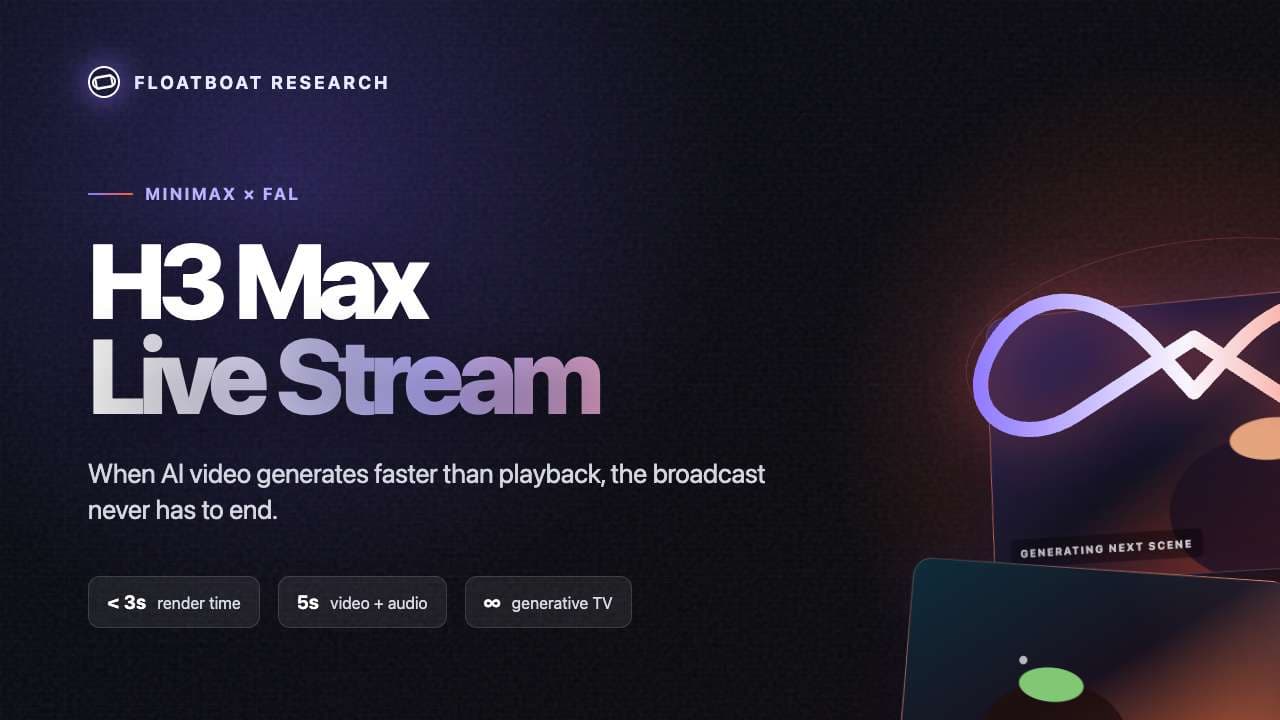
MiniMax H3 Max Live is an experimental use of fal's post-trained H3 Max video model where generation speed exceeds playback speed, so a broadcast can run continuously while new clips are produced in the background — the technical prerequisite for "infinite" AI livestreams.
-
H3 Max (the production API model) renders a 5-second 768p clip with synchronized audio in under 3 seconds on fal's stack, roughly 35× the throughput of MiniMax's official H3 endpoint, according to fal's published benchmarks.
-
In late August 2026, fal engineer Rehan Sheikh connected H3 Max to Twitch and dubbed the result "Infinite Interdimensional Cable"; fal followed with an official H3 Max Live experiment where viewers type
!promptin chat to steer the next scene within seconds. -
This is not MiniMax M3 or the MiniMax Realtime voice API — it is a video-generation workflow built on MiniMax H3, fal's accelerated variant, and an experimental continuity endpoint.
-
Running a 24/7 stream at continuous generation is expensive — roughly $3,500/day at fal's launch promo rate ($0.04/s at 768p) or ~$6,900/day at list pricing ($0.08/s) — which is why most public demos have been sponsored experiments rather than sustainable channels.
1. Why Faster-Than-Playback Changes the Video Category
For two years, AI video tools were judged on clip quality: how photorealistic the frames look, how well the model follows a prompt, whether native audio lands in sync. Latency was a secondary concern because the dominant workflow was batch production — write a prompt, wait two to five minutes, download a fifteen-second file, iterate. That model works for ads, social clips, and storyboards. It does not work for television.
Television, in the literal sense of a signal that never stops, requires the next segment to exist before the current one finishes. If generating fifteen seconds of footage takes nine minutes, you cannot broadcast live; you can only replay a growing archive. The moment generation time drops below playback time, the constraint flips: the system can append new material while the audience is still watching the previous clip. Infinite runtime becomes a queue-management problem instead of a physics impossibility.
That is the shift fal demonstrated in August 2026. Its H3 Max variant — a post-trained, inference-co-designed version of MiniMax H3 — generates short clips fast enough that engineers could pipe output into a live broadcast stack and keep the buffer full. The demos were playful (chat-driven surrealism, Rick and Morty "Interdimensional Cable" references), but the underlying capability is serious: real-time generative media supply chains for channels, personalized feeds, and interactive entertainment. The category move is from "wait for the render" to "never stop generating" — and that only becomes viable when throughput crosses the playback line.
2. MiniMax H3 Max Live Defined
2.1 The Core Definition
MiniMax H3 Max Live is not a separate product SKU you can buy off a pricing page today. It names a live-broadcast pattern : loop fal's H3 Max text-to-video or image-to-video API, enqueue clips faster than they play, merge chat prompts into the next generation request, and push the composite stream to a platform such as Twitch through standard RTMP tooling (OBS or equivalent). "Live" here means continuous generative supply , not low-latency speech conversation — a distinction that matters because MiniMax also ships an unrelated Realtime API for voice.
The fal-branded H3 Max Live experiment added an experimental endpoint that fal engineers said supports native continuity across scenes — preserving audiovisual context instead of treating each clip as an isolated generation. That endpoint was showcased on Twitch with a !prompt chat command: viewers submit a scene description, and fal claimed the new request could appear on screen within seconds. Whether you call it Infinite Interdimensional Cable or H3 Max Live, the architecture is the same class of system: generative video as a stream source rather than a file export.
2.2 Three Product Layers
Confusion spreads quickly because three names sound alike. The table below separates what each layer is for.
Layer | What it is | Resolution / speed | Availability (as of Sep 2026) |
|---|---|---|---|
MiniMax H3 | Open-weight omni-modal video model (base checkpoints on Hugging Face) | Up to 2K, 5–15 s clips; hosted API slower on official MiniMax inference | API + self-host for H3-Base; see our MiniMax H3 breakdown (linked in §1) |
fal H3 Max | Post-trained H3 variant co-optimized with fal's inference stack | 768p default; ~3 s wall time for a 5 s clip (fal blog) | GA on fal: text-to-video and image-to-video |
H3 Max Live | Experimental infinite-stream workflow + continuity endpoint | Same generator; pipeline adds chat steering and cross-scene context | Demo / experiment; fal announced on X Aug 30, 2026; not documented as a public GA API |
Reach for standard H3 when you need 2K, reference-to-video, or editing endpoints. Reach for H3 Max when you need throughput and prompt adherence for high-volume or interactive workloads. Reach for H3 Max Live only as a reference architecture until fal documents a supported continuity API.
2.3 What H3 Max Live Is Not
It is not MiniMax M3. M3 is MiniMax's frontier language model for agentic reasoning and tool use — a text/multimodal LLM with a 1M-token context window, not a video broadcaster. Naming collision is unfortunate; the Twitch story is entirely on the H3 video line.
It is not the MiniMax Realtime voice API. Realtime API targets speech-in / speech-or-text-out conversations with ultra-low latency. H3 Max Live outputs video files in a loop. If you need a voice agent, you are in a different product category entirely — closer to the distinction we draw between voice mode and voice dictation for AI agents.
It is not pre-rendered video pretending to be live. Early "AI streams" sometimes looped a finite library of clips. The August 2026 demos claimed on-the-fly generation for each segment, with chat altering the next prompt. That claim is credible only because H3 Max's throughput makes the queue sustainable; without faster-than-playback generation, the illusion collapses the moment chat outruns the buffer.
It is not a cheap always-on hobby channel. List pricing on fal's H3 Max product page runs about $0.08 per second at 768p after promotional pricing ended September 1, 2026 — roughly $4.80 per minute of generated footage if you generate continuously at full duration. A naive 24/7 channel at that rate implies thousands of dollars per day before platform fees, moderation, and engineering overhead. Treat public streams as capacity proofs , not unit-economics templates.
3. How the Infinite Livestream Pipeline Works
Understanding the pipeline clarifies which bottlenecks remain even when raw generation is fast.
3.1 Generation Loop
At the core is a worker loop calling fal's HTTP API — endpoint minimax/h3-max/text-to-video or minimax/h3-max/image-to-video — with a prompt derived from a base show bible, the previous clip's ending frame, and the latest chat instruction. Each successful response returns a short MP4 with native audio (H3 Max inherits H3's joint audiovisual generation). Workers run in parallel where budget allows: while clip n plays, clips n+1 and n+2 generate concurrently so a single slow request does not stall the broadcast.
fal exposes a timings.inference field on responses — the backend denoising time — which landed near 2.5 seconds for a 5-second 768p clip in fal's public materials. Longer durations scale roughly linearly; a 15-second clip might take on the order of 9–15 seconds depending on resolution and settings, still at or below playback duration in the demos that made headlines.
3.2 Playback Buffer
Live video platforms consume a steady media stream, not discrete API responses. The bridge is a buffer queue : finished clips are concatenated or cross-faded into a playout server, which emits RTMP to Twitch, Kick, YouTube Live, or a standalone HLS page. The buffer depth is the safety margin. If generation averages 0.6× realtime (nine seconds to produce fifteen seconds of content), the queue grows while chat is quiet and drains when prompts pile up. If chat spikes faster than workers can render, the stream stutters or repeats hold frames — the same failure mode as any live production, except the upstream "camera" is a GPU cluster instead of a lens.
Sheikh's original demo and fal's H3 Max Live stream both relied on this inequality: generation time < clip duration. That is why fal's launch post emphasized throughput multiples against MiniMax's official H3 API rather than a single beauty-frame benchmark. Infinite runtime is a systems result, not a magic model flag — and it fails the moment average generation latency rises above clip length.
3.3 Chat-to-Prompt Steering
Interactivity is what separates a screensaver from a show. fal's H3 Max Live announcement instructed viewers to type !prompt followed by a scene description in Twitch chat; moderators or bots parse the command, enqueue the text as the next generation prompt, and optionally summarize prior chat context so the model does not reset narrative coherence each clip.
Indie developer Pieter Levels built Infinite Slop — a standalone site with a similar chat-driven loop — shortly after seeing Sheikh's experiment, and publicly credited Marc-Antoine Fontaine and Rehan Sheikh for the underlying idea. Levels reported operational costs on the order of $4,000 per day for his variant (sponsored by fal in public posts), which aligns with back-of-envelope math at fal's per-second rates if generation never idles. Chat steering is cheap in software; GPU time is not.
3.4 Broadcast and Moderation Layer
The final layer is ordinary streaming infrastructure: OBS or a custom FFmpeg pipeline, stream keys, bitrate caps, and platform community guidelines. AI-generated infinite streams introduce moderation debt — chat can request NSFW or policy-violating scenes faster than human reviewers can intervene, which likely contributed to early friction on mainstream platforms (see §5). Technical feasibility and platform policy are separate gates; passing the first does not guarantee a durable home on Twitch.
4. The August 2026 Timeline
The event chain is unusually well documented because it unfolded in public posts and same-week media coverage.
Date | Event | Source tier |
|---|---|---|
Jul 31 – Aug 3, 2026 | MiniMax H3 open-weights release | Tier 0 — MiniMax / Hugging Face |
~Aug 27, 2026 | fal releases H3 Max (post-trained, co-optimized inference) | Tier 0 — fal blog |
Aug 29, 2026 | fal engineer Rehan Sheikh connects H3 Max to Twitch; "Infinite Interdimensional Cable" | Tier 2 — X posts; Tier 1 — CryptoBriefing |
Aug 30, 2026 | fal announces H3 Max Live; Twitch channel with | Tier 2 — @fal / @BlendiByl X threads |
Aug 30+, 2026 | Pieter Levels launches Infinite Slop (chat-driven, standalone hosting) | Tier 2 — community posts |
Aug 30+, 2026 | MiniMax official account reposts the experiment (per Chinese financial media) | Tier 1 — secondary reporting |
MiniMax's H3 team publicly endorsed the fal partnership in fal's launch post, noting that H3 Max combines "SOTA video quality with a step-change in generation speed." The livestream demos were ecosystem validation more than a MiniMax product launch — fal built the speed layer; MiniMax supplied the base model weights and brand gravity.
5. Platform Policy and Cost Reality
5.1 Twitch, Kick, and Rumble
CryptoBriefing reported that Sheikh's stream left Twitch quickly , encountered similar friction on Kick, and found a more permissive environment on Rumble — all attributed to automated moderation flagging fully AI-generated, chat-steered content. That account is single-source Tier 1 ; fal's later Twitch-hosted H3 Max Live announcement suggests at least some experiments continued on Twitch under fal's own channel, possibly with different moderation setup or category choice (Just Chatting vs automated categories).
The practical takeaway for builders: platform fit is unsettled. Mainstream live platforms optimize for human creators and clear content policies; an infinite AI feed with open chat prompts sits in a gray zone — part performance art, part unmoderated generative firehose. Expect policy to lag capability by months, similar to early deepfake and bot-stream debates.
5.2 Economics of Always-On Generation
Use fal's published pricing as a floor, not a ceiling. After the launch promotion, 768p H3 Max list pricing is $0.08 per second of generated video on the product page — about $288 per hour if workers generate sixty minutes of footage every clock hour. A full day at that duty cycle approaches $6,900 before redundancy, failed generations, or prompt-expansion overhead. Promotional rates ($0.04/s during the first two weeks) halve that figure; free daily sandbox generations are irrelevant at channel scale.
Compare to Levels' cited ~$4,000/day for Infinite Slop: the number is plausible if generation is intermittent, resolution lower, or fal subsidized compute for marketing. None of that implies a profitable creator business without sponsorship, tipping, or a downstream product funnel. Infinite AI TV is currently a demo class , not a default content strategy — the same way early one-prompt HTML game experiments were demos of model capability, not game studios.
5.3 Moderation and NSFW Risk
Community observers noted NSFW edge cases in open chat-driven streams — predictable whenever prompts are unconstrained. Architecturally, you mitigate with prompt filters, human moderators, delayed playout (a 30-second buffer to kill bad clips), and category restrictions. None of those are solved by faster models; they are production requirements if you leave chat in the loop.
6. What This Means for Creators and Developers
The durable insight from H3 Max Live is not "start a Twitch channel today." It is that generative video is acquiring a realtime supply curve — and that unlocks workflows beyond broadcast gimmicks. Automated channels — news recaps, ambient loops, localized storefront videos, always-on tutorial feeds — become technically feasible when each segment is generated on demand rather than pulled from a finite CMS. Interactive narratives, where the audience votes on the next scene or steers RPG-style worldbuilding, need both throughput and continuity; H3 Max Live's experimental endpoint targets the second problem while H3 Max solves the first. Advertising pipelines can treat video as a function call: product feed in, variant clip out, no overnight render farm queue.
Developers evaluating fal should treat the public H3 Max API as production-grade for clip generation and the Live continuity endpoint as a preview — watch fal's changelog before baking cross-scene memory into a paid product. Teams already on MiniMax H3 for 2K or Ref2VA should keep standard H3 endpoints for quality-critical shots and route bulk or interactive workloads to H3 Max when latency dominates.
For agent builders, the parallel is familiar: unified context plus fast execution changes what "always on" means — whether the output is video or a work week. Calendar-driven agents that trigger prep before meetings face the same queue problem in a different medium: can the system finish the next artifact before the human arrives? H3 Max Live answers yes for fifteen-second video clips; agentic calendar systems aim at the same inequality for documents and follow-ups.
7. Conclusion
MiniMax H3 Max Live marks the moment AI video crossed from "batch artifact" to "continuous source" — not because someone invented a new codec, but because fal's post-training and inference co-design pushed H3 Max past the playback line. Rehan Sheikh's Twitch experiment and fal's official H3 Max Live stream were proofs that the buffer math works; Pieter Levels' Infinite Slop proved chat steering attracts an audience; platform moderators proved policy has not caught up.
If you build on this stack, start with short clips and a deep buffer , measure timings.inference on your prompts, and price GPU time before you price ads. If you only need occasional B-roll, standard H3 or H3 Max clip mode is simpler and easier to QA. Infinite livestream is a specialty application — spectacular when it works, expensive when it runs literally forever.
Frequently Asked Questions
Is H3 Max Live the same as MiniMax H3?
Can I run an infinite AI livestream on fal's public API today?
Why would Twitch or Kick flag an AI livestream?
How much does a 24/7 H3 Max AI stream cost?
How is this different from MiniMax M3 or the Realtime API?
When should I use H3 Max vs standard MiniMax H3?
https://floatboat.ai/blog/minimax-h3-max-infinite-ai-livestream