OpenAI 4-Day Work Week: Rise of One-Person Companies
OpenAI wants a 4-day work week. But solo operators are already living the AI-powered version. Here's what that actually looks like.133 chars

Hi, I'm Nova. Okay, so I've been sitting with this news for a few days now, trying to figure out what I actually think about it. OpenAI dropped a 13-page policy document last week, and the headline that everyone ran with was the four-day work week angle. My feed exploded. A lot of hot takes. A lot of people argue about whether it's genuine or just corporate positioning.
I'm going to stay out of the political debate — there are smarter people than me for that conversation. But there's a piece of this that I keep thinking about specifically as someone who runs everything solo, and I want to talk through it.
OpenAI's 4-Day Work Week: What It Actually Signals
The Announcement and Its Context
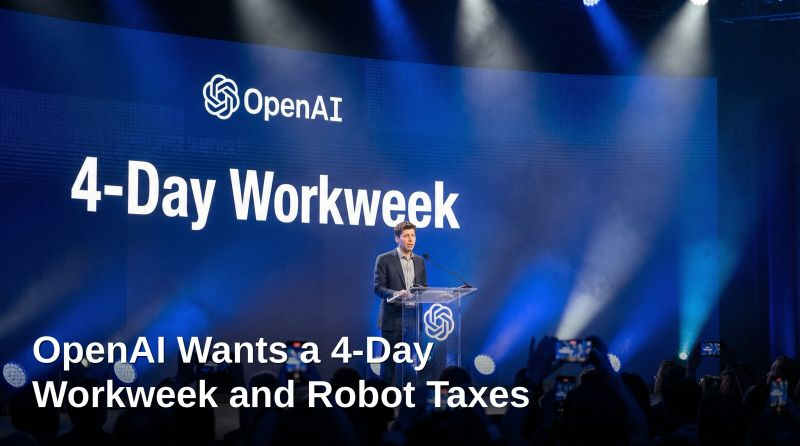
On April 6, 2026, OpenAI published a policy document titled "Industrial Policy for the Intelligence Age: Ideas to Keep People First." The four-day work week proposal was one item in a much broader package that included a robot tax, a national public wealth fund, and automatic safety net triggers tied to AI displacement metrics.
As reported by Quartz, OpenAI called for government-backed experiments with 32-hour schedules that maintain current pay levels — framing reduced hours as an "efficiency dividend," converting AI-driven productivity gains into time back for workers rather than purely into corporate margins.
TechCrunch's coverage of the OpenAI policy document flagged something worth noting: OpenAI frames these as corporate responsibilities, not government guarantees. The company building the automation is suggesting the companies using that automation should absorb the transition costs. That's a notable framing choice for an $852 billion business approaching an IPO.
I could be wrong here, but reading the document as pure altruism feels generous. Reading it as pure cynicism feels too easy. The honest version is probably: they see disruption coming and they're trying to shape the policy conversation before someone else does.
What It Says About AI Productivity Assumptions
The embedded assumption in the four-day work week proposal is significant: AI will make knowledge workers productive enough that five days of output can fit into four. That's the premise. The efficiency gains are real, the reasoning goes — the question is who captures them.
As Unite.AI summarized the proposal, OpenAI suggests governments incentivize employers to pilot 32-hour working weeks tied to productivity gains from AI adoption — framing it as workers receiving a share of the value AI creates, rather than that value flowing entirely to shareholders.
Wait — that framing is actually interesting. Whether you believe it or not, it's forcing a public conversation about a question most companies haven't answered: when AI makes your team twice as productive, where does that efficiency go?
Solo Operators Already Figured This Out
Running a Business Solo in an AI-First World
Here's the thing that struck me reading all this coverage: the conversation about AI productivity and work hours is almost entirely framed around employees and employers. The solo operator — one person running a business, doing work that used to require a team — barely registers in these policy proposals.
And yet that's exactly the use case where AI productivity gains are most legible and most immediate. There's no negotiation required. There's no manager deciding where efficiency goes. If AI helps me compress three hours of research into forty-five minutes, I get those two hours and fifteen minutes back. Full stop.
I've been living this for the past year. I won't pretend I've cracked a four-day work week — I haven't, and I'm suspicious of anyone who tells you they have without caveats. But I have genuinely changed what a "full day of work" looks like for me, and AI tools are a large part of why.
What "Doing the Work of a Team" Looks Like
The interesting thing about running a solo operation in 2026 isn't that AI does everything — it's that AI handles the parts of the work that used to require dedicated people. Research synthesis, first drafts, formatting, scheduling logic, status updates.
What's left is the judgment layer. Deciding what matters. Evaluating what the AI produced. Making the call when the AI gives you two plausible options and neither is quite right. That's still human work, and it's actually the part that compounds over time.
The four-day week conversation matters for solo founders not because of labor policy — it doesn't apply to us directly — but because it signals that the broader economy is starting to grapple with a question we've already been running experiments on: what happens when the work capacity of one person expands significantly?
AI, Work, and the "Robot Tax" Debate
What Sam Altman's Proposals Mean
The broader policy package is worth understanding even if you're not a policy person. The robot tax proposal — taxing automated labor at rates comparable to the human workers it replaces — would, if enacted, change the economics of AI adoption for businesses of all sizes.
As The Next Web reported, OpenAI's "Industrial Policy for the Intelligence Age" proposes shifting the tax base from payroll and labor income toward corporate income, capital gains, and taxes on automated labor — with the reasoning that as AI expands corporate profits while automating wage labor, the tax base funding Social Security, Medicaid, and SNAP would otherwise erode.
This is a structural argument, not just a political one. And the underlying math is real: if enough jobs get automated, the employment-based tax revenue that funds public programs shrinks, regardless of how you feel about the politics.
Where Solo Operators Sit in This Debate
Honestly? Somewhat awkwardly. Solo operators using AI tools are part of the productivity story, but we're not the ones displacing teams of workers. We're one person choosing to use AI instead of hiring — which is a different calculation than a company replacing 50 employees with automation.
I don't have a clean answer here. I use AI tools because they make my work better and more manageable. Whether that's creating economic harm at a systemic level is a question above my pay grade. What I can say: the policy conversation isn't really about people like us. It's about large-scale automation in organizations. We're mostly bystanders in that debate, even if we're using the same underlying tools.
How to Run at Full Capacity Without Burning Out
The Systems That Make It Sustainable
The four-day work week conversation is really a conversation about sustainable output. And the question that actually matters for solo operators isn't "can I work four days?" — it's "can I structure my work so that output stays consistent without the wheels coming off?"
Research published in MIT Sloan Management Review studied 245 organizations that implemented four-day weeks, finding that companies using the "100-80-100" model — 100% pay, 80% hours, 100% productivity — reported steady or improved output alongside significant well-being improvements. The mechanism, researchers found, wasn't working harder in fewer hours. It was reorganizing how work happened.
That reorganization piece is exactly where AI tools can help — and where most people underuse them. It's not about replacing work. It's about changing which tasks need your brain and which ones can run on autopilot.
For me, that's meant building workflows instead of just using AI for one-off tasks. The difference is real. A prompt gives you an output once. A workflow gives you the same quality output every time, without re-doing the setup.
Where AI Amplification Breaks Down
I want to be honest about this part because the "AI makes you infinitely productive" narrative is oversold.
Researcher Juliet Schor, who studied over 8,700 workers across four-day week pilots, found that employees rated their work-life balance higher and experienced less burnout — but also noted that "it's really hard to keep everyone in jobs if you're displacing labor with technology."
The burnout risk for solo founders specifically is different from what large-scale studies capture. When you're the only person in the business, there's no organizational slack to absorb overload. AI can expand your capacity, but it can't create boundaries for you. I've had weeks where AI made me more productive and I just filled that productivity with more work — and ended up more tired, not less.
The APA's research on the four-day workweek flagged something worth noting: about 80% of workers reported they'd be happier and just as effective with a four-day week — but the research also found that the gains can fade over time as the novelty wears off and intensity increases to compensate. The tool doesn't create sustainability. The system does.
For solo operators, that system usually means having clear stopping criteria — knowing what "done" looks like before you start — and not treating AI-freed time as permission to take on more projects.
The OpenAI four-day work week proposal is interesting as a policy signal — it tells you something about how the company sees AI disruption unfolding. But for someone running a one-person operation, the more useful frame is simpler: AI gives you capacity. What you do with that capacity is a choice, not an automatic outcome.
The four-day week is a nice idea. The more achievable version, for people like me, is a calmer week — fewer tasks that don't need my brain, more time on the work that does.
Previous Posts:
-
Learn why AI still resets every session and what that means for your workflow
-
See what an AI workflow for solo founders actually looks like in practice
-
Understand how one-person businesses operate like a full team with AI
-
Explore the difference between AI assistants and real AI agents
-
Go deeper into what a persistent AI agent means for long-term productivity
Frequently Asked Questions
Is a four-day work week realistic for solo founders?
What exactly is OpenAI proposing with the four-day work week?
What does the four-day week debate have to do with one-person companies?
Does AI actually reduce work hours?
Why can AI leave solo founders more tired instead of less?
What tools actually enable this shift?
https://floatboat.ai/blog/openai-4-day-work-week-one-person-company