
TL;DR
-
A DeepSeek Agent is any AI agent that uses a DeepSeek model — typically V4 Pro or V4 Flash — as its primary reasoning engine, routing tool calls, planning multi-step tasks, and maintaining context across sessions through that model.
-
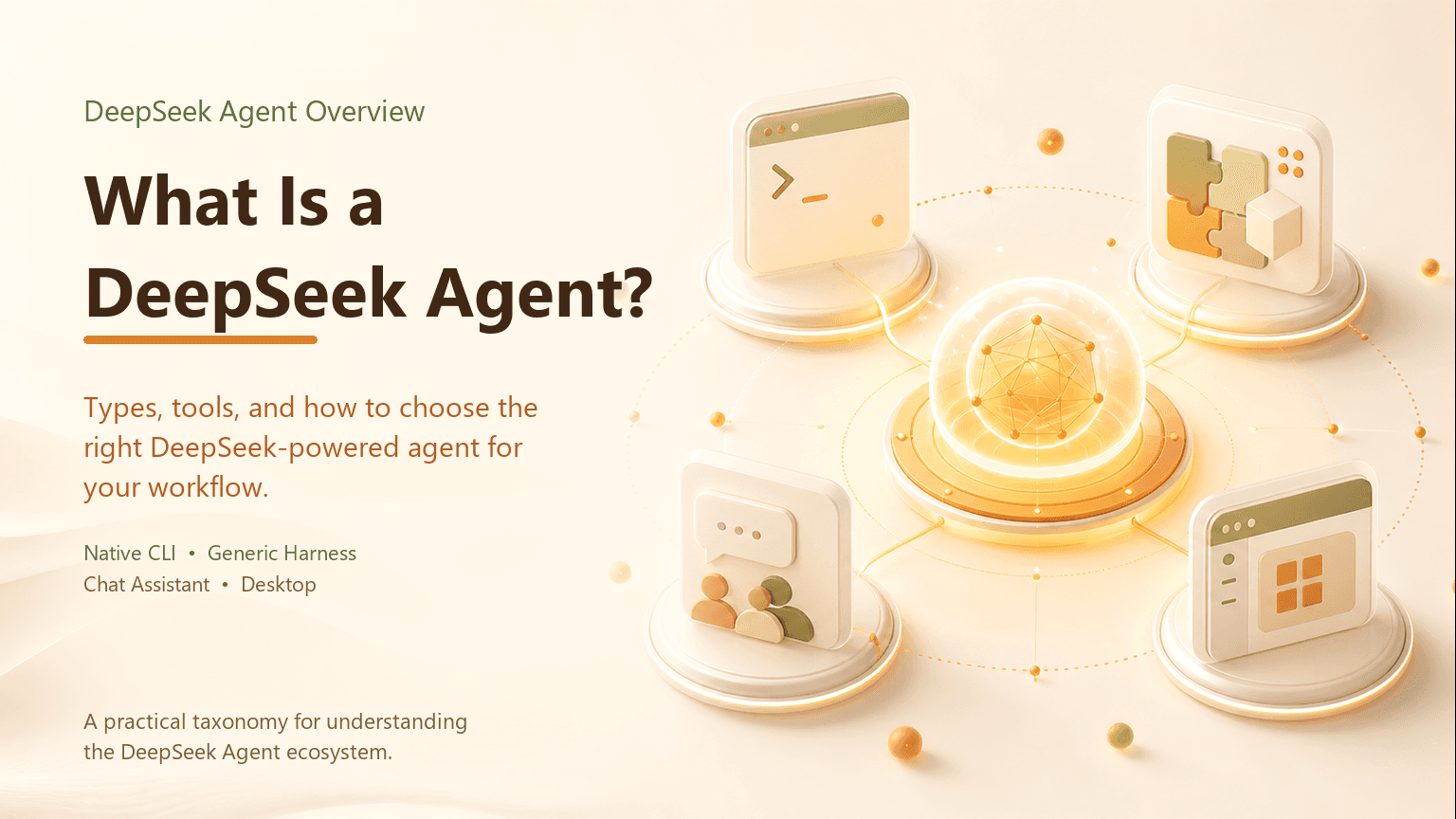
There are four distinct archetypes: Native CLI Agents built specifically around V4's strengths (DeepSeek-TUI, Reasonix, Deep Code), Generic Harnesses that drop DeepSeek into existing tools (Claude Code, Cline, OpenCode), Chat-Platform Assistants that embed agents in messaging apps, and Desktop Orchestrators that combine visual interfaces with agentic workflows.
-
DeepSeek released V4 Pro and V4 Flash in April 2026 with a 1-million-token context window and native function calling — then published an official awesome-list of 22 agent integrations, signaling that agentic workloads are the primary use case these models were designed for.
-
None of the current DeepSeek Agents is an official product from DeepSeek itself. The company is hiring a Harness team, and the community-built deepseek-tui already implements most of the architecture described in that job posting — making it the closest thing to a reference implementation.
1. Why "DeepSeek Agent" Is a Search Term Worth Understanding
Three months after DeepSeek released V4 Pro and V4 Flash on April 24, 2026, the company opened a GitHub repository called awesome-deepseek-agent. It contained setup guides for 22 different tools — terminal coding assistants, IDE extensions, chat-platform bots, and desktop clients — all configured to use DeepSeek's V4 models as their backend. The repository collected roughly 4,700 stars in its first three months, as tracked on the official awesome-deepseek-agent repository.
That repository is not a product launch. It is a signal. DeepSeek is telling developers: our models are ready for agentic workloads, and here is how to point the tools you already use at them.
The number matters because it reflects how quickly the developer ecosystem organized itself around a question that didn't have a clean answer before April: what exactly counts as a DeepSeek Agent? The term now appears in integration guides, benchmark comparisons, and hiring posts — but it is being used to describe fundamentally different things. A terminal-based coding agent that fans out 16 parallel V4 Flash sub-agents under a single V4 Pro coordinator is not the same category of tool as a chatbot plugin that routes WeChat messages through the same API. Calling both "DeepSeek Agents" is technically correct but practically useless for anyone trying to decide what to use.
This article defines the category. It gives you a framework for distinguishing the four archetypes, understanding what each is good at, and choosing the right starting point for your own work — whether that means dropping DeepSeek into your existing Claude Code setup or installing a purpose-built native agent.
2. What a DeepSeek Agent Actually Is
2.1 The Core Definition
A DeepSeek Agent is any AI agent that uses a DeepSeek model as its primary reasoning engine — the model that decides which tool to call, plans the next step in a multi-turn task, and synthesizes results into a coherent response. It is not a specific product or a single codebase. It is a category defined by the model at the center of the agent loop.
When Claude Code is configured to route its API calls to https://api.deepseek.com/anthropic with deepseek-v4-pro as the model, Claude Code becomes a DeepSeek Agent for the duration of that session. When a developer runs deepseek-tui in their terminal and it spawns a V4 Pro coordinator that fans out work to 16 parallel V4 Flash sub-agents, that setup is also a DeepSeek Agent — but the architecture, the tool surface, and the target user are completely different.
The common thread is the model. DeepSeek V4 Pro and V4 Flash both expose a 1-million-token context window, support up to 128 parallel function calls, and ship with pre-tuned adapters for popular agent harnesses, as documented in DeepSeek's coding agent integration guide. These capabilities make DeepSeek viable as the core reasoning engine in agentic workflows that were previously only practical with much more expensive closed-source models.
2.2 Four Archetypes of DeepSeek Agents
After analyzing all 22 tools in the official awesome-deepseek-agent list, plus community projects not included there, four distinct patterns emerge. They differ in architecture, target user, and how tightly they are coupled to DeepSeek's specific capabilities.
Archetype | What it is | Example tools | Who it's for |
Native CLI Agent | Purpose-built terminal agent designed around V4's strengths: 1M context, prefix caching, RLM fan-out | DeepSeek-TUI, Reasonix, Deep Code | Developers who want a coding agent optimized for DeepSeek's cost-performance profile |
Generic Harness + DeepSeek | Existing agent harness reconfigured to use DeepSeek as the backend model | Claude Code + DS, Cline + DS, OpenCode + DS, Codex + DS | Developers already using a harness who want lower API costs without switching tools |
Chat-Platform Assistant | Agent plugged into messaging platforms (Feishu, Telegram, WeChat) with DeepSeek as the reasoning backend | AstrBot, OpenClaw, nanobot | Teams that want agentic capabilities inside their existing communication channels |
Desktop Orchestrator | GUI-based agent client that combines chat, tool use, and multi-model routing through a visual interface | Cherry Studio, LobeHub, WorkBuddy/CodeBuddy | Users who prefer a desktop app over terminal workflows |
This taxonomy is not academic. It maps directly to the decisions you make when choosing a DeepSeek Agent: whether you need a coding-specific tool, whether you want to stay inside an existing harness, and whether you need a visual interface or a command-line environment.
The Native CLI agents are the most architecturally interesting category because they are built from the ground up around V4's specific capabilities. DeepSeek-TUI, for example, implements Recursive Language Model (RLM) fan-out — a pattern where a single V4 Pro coordinator spawns up to 16 parallel V4 Flash sub-agents, each working on a different part of a task, then merges their results. At V4 Flash's pricing of $0.14 per million input tokens and $0.28 per million output tokens, running 16 parallel sub-agents costs less than a single Claude Opus call. This is not an optimization — it is an architectural shift enabled by DeepSeek's pricing.
Reasonix takes a different approach. It builds its agent loop around DeepSeek's KV cache architecture, maintaining long-running sessions where repeated context is served from cache at $0.003625 per million tokens rather than $0.435 per million. For coding sessions that span hours and accumulate thousands of tokens of conversation history, that cache-hit discount changes the economics of what is practical to keep in memory.
2.3 What It Is Not
Three things are frequently called "DeepSeek Agents" that do not fit the definition.
First, general LLM agent platforms that list DeepSeek as an optional model provider. Dify, Coze, FastGPT, and n8n all support DeepSeek models, but DeepSeek is one option among many in their routing layer. These platforms are model-agnostic agent builders, not DeepSeek Agents — the architecture is not optimized for DeepSeek's specific strengths, and the user experience does not change meaningfully based on which model is selected.
Second, bare API calls with tool definitions. Sending a chat completion request to deepseek-v4-pro with a tools array is using the DeepSeek API for function calling — it is the raw material of agent-building, not an agent itself. An agent requires a loop: the model outputs a tool call, your code executes it, the result is fed back into context, and the model decides the next step. A single tool call is one turn in a longer process.
Third, SEO landing pages that claim to be DeepSeek Agents. Several domains (notably deepseekagent.io) present themselves as DeepSeek Agent products but are actually affiliate content teaching users how to configure Claude Code or Codex to use DeepSeek's API. These are marketing funnels, not software.
3. The DeepSeek-Native Agents: Built Around V4's Strengths
The three agents listed in DeepSeek's official awesome-list under the DeepSeek-native category — DeepSeek-TUI, Reasonix, and Deep Code — represent the current frontier of what is possible when an agent is designed from scratch around V4's architecture rather than retrofitted onto it.
DeepSeek-TUI is a terminal-based coding agent written in Rust by independent developer Hunter Bown. As of July 2026, it had roughly 2,300 GitHub stars and was the most actively developed community project in the DeepSeek Agent ecosystem. Its architecture mirrors what DeepSeek's own Harness team job posting describes: an agent loop with RLM fan-out, a sandboxed tool environment, MCP client and server support, LSP integration for post-edit diagnostics, and three execution modes — Plan (read-only analysis), Agent (step-by-step with human approval), and YOLO (fully autonomous). The tool makes aggressive use of the 1M token context window, and its sub-agent pattern (1 V4 Pro coordinator + 1 to 16 V4 Flash children) is a production demonstration of the cost asymmetry that DeepSeek's pricing enables.
What makes DeepSeek-TUI notable is not its feature list but the fact that it was built by one developer in a few months and already implements most of the architecture DeepSeek's internal Harness team is being hired to build. It is the closest thing to a reference implementation for what a DeepSeek-native coding agent should look like — and it is MIT-licensed, meaning the architecture is publicly documented and forkable.
Reasonix takes a different architectural bet. While DeepSeek-TUI optimizes for parallelism, Reasonix optimizes for session economics. It is built around DeepSeek's prefix caching — the mechanism that stores repeated context prefixes in KV cache and serves them at roughly 1/120th the cost of a cache miss. In practice, this means a multi-hour coding session where the system prompt and project context remain stable will see dramatically lower per-turn costs after the first few exchanges. Reasonix defaults to V4 Flash and upgrades to V4 Pro only when the task complexity warrants it, making it the most cost-conscious of the native agents.
Deep Code by vegamo is a Node.js terminal and VS Code extension agent that focuses on reasoning effort control — letting users toggle between thinking modes (non-think, Think High, Think Max) depending on the task. For a quick bug fix, you run it in non-thinking mode on V4 Flash. For a multi-file refactor that requires chain-of-thought reasoning, you switch to Think Max on V4 Pro. Deep Code is listed in DeepSeek's own integration guides, which gives it a degree of official visibility that the other community agents do not yet have.
The common thread across all three is that they treat V4's capabilities — 1M context, KV cache discounts, thinking modes, 128 parallel tool calls — as architectural primitives, not optional features. A generic harness configured to use DeepSeek can access these capabilities, but it was not designed around them. The native agents were.
4. Generic Harnesses with DeepSeek: The Drop-In Approach
If you are already using Claude Code, Cline, OpenCode, Codex, or any other agent harness that speaks the OpenAI or Anthropic API format, adding DeepSeek support is typically a one-line configuration change.
For OpenAI-compatible harnesses, you change the base URL to https://api.deepseek.com and the model name to deepseek-v4-pro or deepseek-v4-flash. For Anthropic-compatible harnesses like Claude Code, you point the ANTHROPIC_BASE_URL environment variable to https://api.deepseek.com/anthropic, as detailed in DeepSeek's agent integration documentation. If you want a step-by-step walkthrough of writing an agent loop with this setup, How to Build a DeepSeek Agent covers API setup, tool calling, and production patterns with runnable code.
This approach has a clear advantage: zero switching cost in terms of workflow. Your muscle memory for Claude Code's /compact, Cline's plan-act-approve cycle, or OpenCode's diff review flow stays intact. The only thing that changes is the model generating the responses — and your API bill.
The downside is equally clear: these harnesses were designed around the capabilities of their original models (Claude Opus for Claude Code, GPT-4o for Codex). They benefit from DeepSeek's lower cost but do not take full advantage of features that are specific to V4. DeepSeek-TUI's RLM fan-out pattern, for example, requires the harness to understand that V4 Flash is cheap enough to run 16 copies in parallel for sub-tasks — a design decision that generic harnesses do not make because it would be economically irrational with Opus or GPT-4o pricing.
In practice, many teams are adopting a hybrid approach: keep using Claude Code or Cline as the primary interface, route routine tasks to V4 Flash to keep costs down, and escalate to the harness's native model (Claude Opus or GPT-5.5) only for the hardest architectural decisions. DeepSeek's Anthropic-compatible endpoint makes this pattern trivial to implement — it is the same API surface with a different model string. For a full cost and benchmark comparison between the two approaches, DeepSeek Agent vs Claude Code breaks down the trade-offs by task type.
A useful rule of thumb emerged from developer discussions in mid-2026: if a task involves boilerplate implementation, single-file changes, or straightforward debugging, route it to DeepSeek V4 via your existing harness. If the task requires repo-scale architectural reasoning across multiple interdependent modules, the marginal intelligence gain from a frontier closed-source model is still worth the cost — at least for now.
5. Chat Platforms and Desktop Clients: Agents Without the Terminal
Not every DeepSeek Agent runs in a terminal. Two other archetypes cover use cases where the interface is a chat app or a desktop window rather than a command line.
Chat-Platform Assistants integrate DeepSeek-powered agents into messaging platforms. AstrBot connects to Feishu, Telegram, and WeChat, letting teams invoke agentic workflows — code review, document summarization, data queries — from inside their existing communication channels. OpenClaw extends this pattern to Discord and Slack. These tools are not coding agents in the traditional sense; their tool surface is narrower (file access, API calls, search) and their primary value is removing the friction of context-switching to a separate agent interface.
The architecture is straightforward: the chat platform receives a message, the assistant routes it to DeepSeek's API with the relevant conversation history and tool definitions, and the response is posted back to the channel. The agent loop is simpler than a coding agent's — typically one to three turns rather than dozens — because the tasks are bounded: "summarize this document," "find the relevant JIRA ticket," "generate a weekly report from these data sources."
Desktop Orchestrators like Cherry Studio and LobeHub provide GUI-based agent clients that support multi-model routing, chat history management, and visual tool configuration. They are the DeepSeek Agent equivalent of ChatGPT's desktop app — designed for users who want agentic capabilities without writing code or memorizing CLI commands. WorkBuddy/CodeBuddy adds workspace-aware features, indexing local project files and letting the agent operate on them through a desktop interface rather than a terminal.
At the more capable end of this category, tools like Floatboat DeepSeek Agent bundle a full workstation around the model: local file access without uploads, a built-in browser the agent can drive, persistent memory that survives sessions, and scheduled automation that runs without being prompted. The model stays the same — V4 Pro or V4 Flash — but the difference between asking it questions in a chat window and giving it a desktop it can actually act on is the difference between advice and finished work.
These two archetypes serve an audience that the terminal-focused tools largely ignore: team members who need agentic assistance but whose workflow does not center on a code editor. A product manager asking AstrBot to summarize the week's engineering commits is using a DeepSeek Agent, just as much as a developer running DeepSeek-TUI to refactor a Rust crate.
6. How to Choose: A Decision Framework
The four archetypes are not competing products so much as different answers to the same question — "how do I put DeepSeek's reasoning behind an agentic workflow?" — asked by different users in different contexts. The decision tree below is a starting point, not a final answer, because the right choice depends on your specific constraints: budget, workflow, existing tooling, and tolerance for experimental software.
If you are writing code and want the lowest cost per agent turn , start with a generic harness configured to use DeepSeek. Point Claude Code or Cline at deepseek-v4-flash for routine work and upgrade to V4 Pro when task complexity demands it. This path has the lowest switching cost and the most mature tooling, because the harness itself has been battle-tested by tens of thousands of developers — only the model backend is changing.
If you are writing code and want to push the architecture as far as DeepSeek's pricing allows , evaluate DeepSeek-TUI. The RLM fan-out pattern (1 coordinator + up to 16 sub-agents) is genuinely novel and cannot be replicated in a generic harness. The trade-off is maturity: DeepSeek-TUI is a fast-moving open-source project maintained by a single developer, not a polished product with a support SLA.
If you need an agent inside your team's chat platform , evaluate AstrBot or OpenClaw. The setup is more involved than a coding agent — you need to configure the messaging platform integration, define the tool surface, and manage conversation state across channels — but the value is in removing the "switch to a different tool" step from your team's workflow.
If you want a visual interface and do not want to touch a terminal , Cherry Studio or LobeHub is the right starting point. These tools are the most accessible entry point into the DeepSeek Agent ecosystem and the least capable for complex multi-step coding tasks. They are not a replacement for a terminal agent; they are a different category of tool for a different category of task.
Decision factor | Native CLI (DeepSeek-TUI) | Generic Harness (Claude Code + DS) | Chat Assistant (AstrBot) | Desktop (Cherry Studio) |
Setup complexity | Medium (install + config) | Low (config change) | High (platform integration) | Low (desktop install) |
Cost efficiency | Highest (purpose-built) | High (model-level savings) | Medium (simpler loops) | Medium |
Task complexity ceiling | High (multi-file refactors) | High (harness maturity) | Low (bounded tasks) | Low-Medium |
Maturity / support | Early (community) | High (commercial harness) | Medium | Medium |
Best for | Cost-sensitive heavy coding | Existing harness users | Team communication workflows | Non-developer agent users |
The table is a snapshot of the current landscape as of mid-2026, and it will shift. The Native CLI category is the fastest-moving: DeepSeek-TUI adds features weekly, and the official Harness launch will likely redefine what "mature" means for that column. The Generic Harness column is the most stable — the value proposition of dropping DeepSeek into an existing harness does not depend on any single tool's roadmap. If you are starting today and want a decision that ages well, the Generic Harness path gives you the most insulation from ecosystem churn.
7. The Official DeepSeek Agent: What We Know
DeepSeek is currently hiring for two roles that signal an official agent product is in development: an Agent Harness Product Manager and an Agent Harness R&D Engineer. The job description for the R&D role lists specific technical requirements that match, almost point-for-point, what the community-built deepseek-tui already implements: context management, tool invocation, file I/O, terminal execution, and test feedback integration, as analyzed in a technical deep-dive of the Harness role.
The existence of these roles does not tell us when an official DeepSeek Agent will ship, but it does tell us what it will look like. The job posting describes a desktop agent product — not a terminal tool, not a chat plugin, but a full desktop application in the vein of Claude Code's desktop app or the Cursor IDE. It will likely be a coding agent first, with other modalities (research, data analysis, general-purpose task execution) added over time.
If you are building on DeepSeek for agentic workflows today, the official agent, when it ships, will not make existing tools obsolete. It will validate the category and raise the baseline for what a DeepSeek-native agent should do — but the community tools already pushing the architecture forward (DeepSeek-TUI's RLM fan-out, Reasonix's cache-first loop) will remain relevant precisely because they explore design patterns that an official product, with its broader user base and conservative release cadence, is unlikely to ship on day one.
Conclusion
"DeepSeek Agent" is a category, not a product — and that is a feature, not a bug. The four archetypes described here — Native CLI, Generic Harness, Chat Assistant, Desktop Orchestrator — cover fundamentally different use cases, and the right choice for a developer refactoring a Rust codebase (DeepSeek-TUI) is not the right choice for a product manager summarizing engineering commits in Feishu (AstrBot).
The unifying thread is economic. DeepSeek V4 Pro costs roughly $0.87 per million output tokens versus Claude Opus 4.8's $25.00 — a roughly 28x gap on output alone. That cost difference changes the calculus of what is practical to automate. Tasks that were economically irrational to run through an agent at Opus pricing — fanning out to 16 parallel sub-agents, maintaining multi-hour coding sessions with full context, running hundreds of agent turns per task — become not just possible but obvious at V4 Flash pricing.
The ecosystem is early. The official DeepSeek Agent does not exist yet. The community tools are fast-moving and unevenly documented. But the direction is clear: DeepSeek's models were designed for agentic workloads, and the tooling around them is maturing faster than the tooling around any open-weight model in recent memory. When you are ready to go deeper on the technical layer that powers every agent — tool definitions, strict mode, parallel execution — DeepSeek Agent Function Calling covers the complete tool-calling stack from schema design to MCP.
Frequently Asked Questions
What exactly is a DeepSeek Agent?
Is there an official DeepSeek Agent from DeepSeek?
Can I use DeepSeek V4 in Claude Code without losing features?
Isn't a DeepSeek Agent just a model with function calling?
Do DeepSeek V4 models support tool calling and MCP?
How should I choose among the four archetypes?
https://floatboat.ai/blog/what-is-deepseek-agent