
How to Automate Weekly TikTok Shop Research with FastMoss and Floatboat
See how Floatboat operates FastMoss in its built-in browser, saves live evidence, compares history, writes and checks a management brief, delivers it, and returns through FloatSchedule.

TL;DR
-
FastMoss supplies the live TikTok Shop signal: markets, categories, products, creators, videos, ads, livestreams, shops, and consumer feedback.
-
Floatboat operates the software itself: it navigates the authorized website, changes filters, opens deeper modules, reads dynamically rendered pages, and captures evidence.
-
The file system becomes operational memory: screenshots, source notes, CSVs, comparisons, reports, decisions, logs, and delivery drafts remain organized on disk.
-
The model becomes an analyst with continuity: it compares the new run with prior snapshots and produces a recommendation, confidence level, risks, and next actions.
-
Floatboat checks its own deliverable: it opens the report in the built-in browser, verifies numbers and sources, checks images, links, layout, and console output, then revises the underlying file if needed.
-
FloatSchedule brings the whole desk back: the next run starts with the same project, rules, history, destinations, and delivery policy—not a blank chat.
How to Automate Weekly TikTok Shop Research with FastMoss and Floatboat
Every Monday at 8, Floatboat runs the desk. Give it one category, one decision policy, and one FloatSchedule, and it can open the live website, investigate the signal, preserve the evidence, write and check the management brief, and leave the operation ready for the next run.
Monday, 8:00 AM.
No analyst needs to remember which ranking page to open. No one rebuilds last week's spreadsheet. No one starts by asking an AI to recall a conversation.
The FloatSchedule starts the assignment itself:
Monitor US Beauty & Personal Care in FastMoss. Find changes that could alter a business decision. Investigate the strongest signals. Save every source and artifact to the project. Submit a management brief.
Floatboat restores the project, opens the authorized FastMoss session in its built-in browser, and gets to work.
This is what happens when FastMoss becomes the vertical intelligence layer inside Floatboat, an Agent operating environment built to work across browsers, files, models, connected services, and time.
08:00 — The calendar starts the work
A normal calendar reminder tells a person to begin. A FloatSchedule starts the Agent assignment.
The assignment carries its working context with it: the market and category, saved FastMoss pages, historical snapshots, decision thresholds, report template, output folder, recipients, and approval boundaries. Floatboat therefore begins with the state of the business, rather than a generic prompt.
In the browser, it can:
-
open the saved FastMoss ranking;
-
confirm the country, category, date range, and ranking type;
-
scan for meaningful changes instead of merely collecting rows;
-
open candidate products;
-
continue through creator, video, paid-media, livestream, VOC, and comment modules;
-
preserve the rendered evidence with source URL and access time.
The browser is not a viewing window on the side of the workflow. It is one of Floatboat's working hands.
A 77% growth signal appeared. Floatboat kept digging.
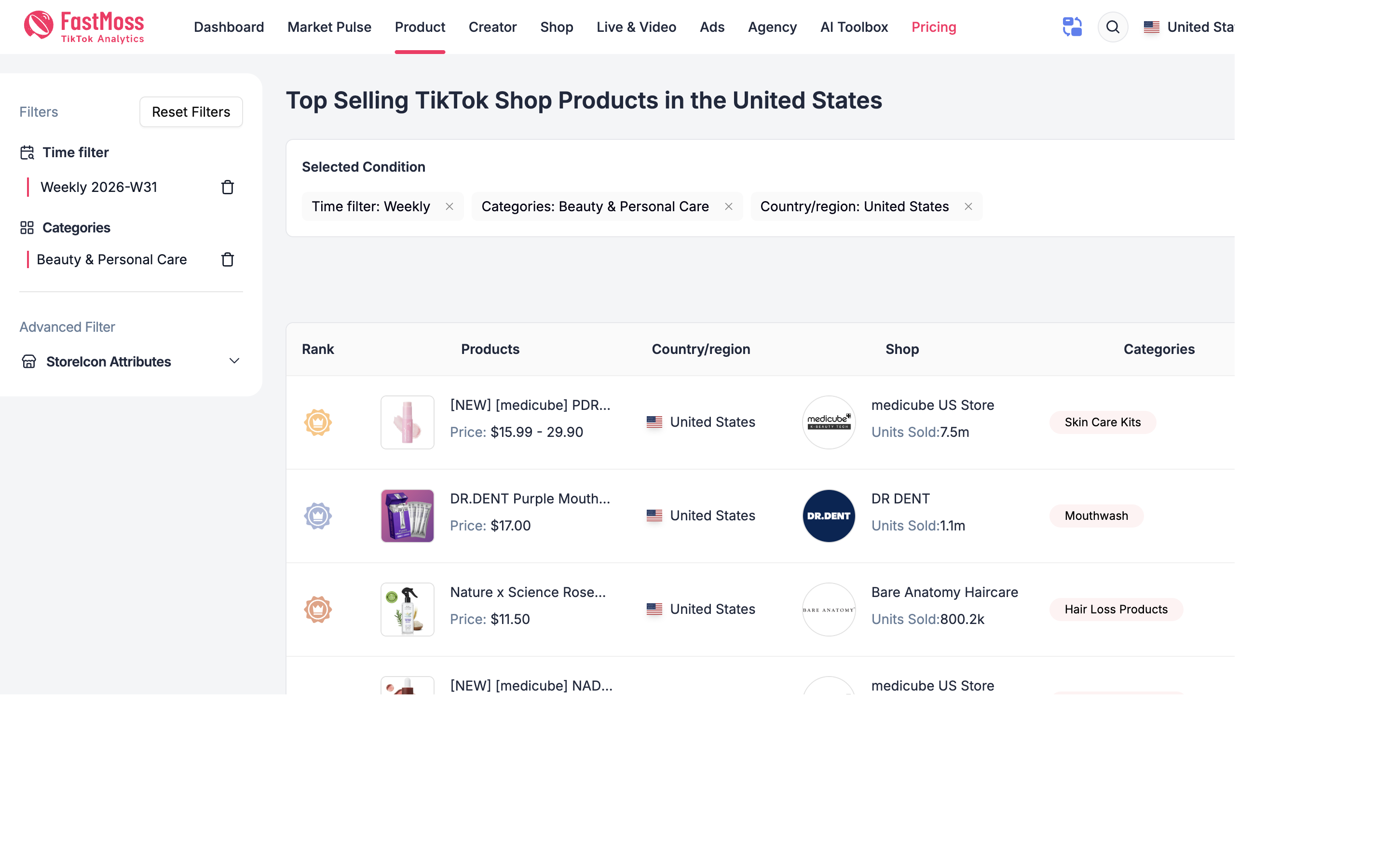
In the US Beauty & Personal Care Week 31 ranking, DR.DENT Purple Mouthwash — Sachets 20 Pack appeared in second place.
FastMoss estimated:
-
20.4K weekly units ;
-
$360.8K weekly GMV ;
-
+77.13% week-over-week unit growth ;
-
a $17.00 price and 15% creator commission.
That was enough to trigger an investigation. It was not enough to justify a commercial commitment.
Floatboat opened the product detail and read the live overview. The product had reached approximately 152.5K cumulative units , $3.153M cumulative GMV , 4,896 commerce creators , and 14.4K related videos. The scale was real. The operating model behind that scale mattered more.
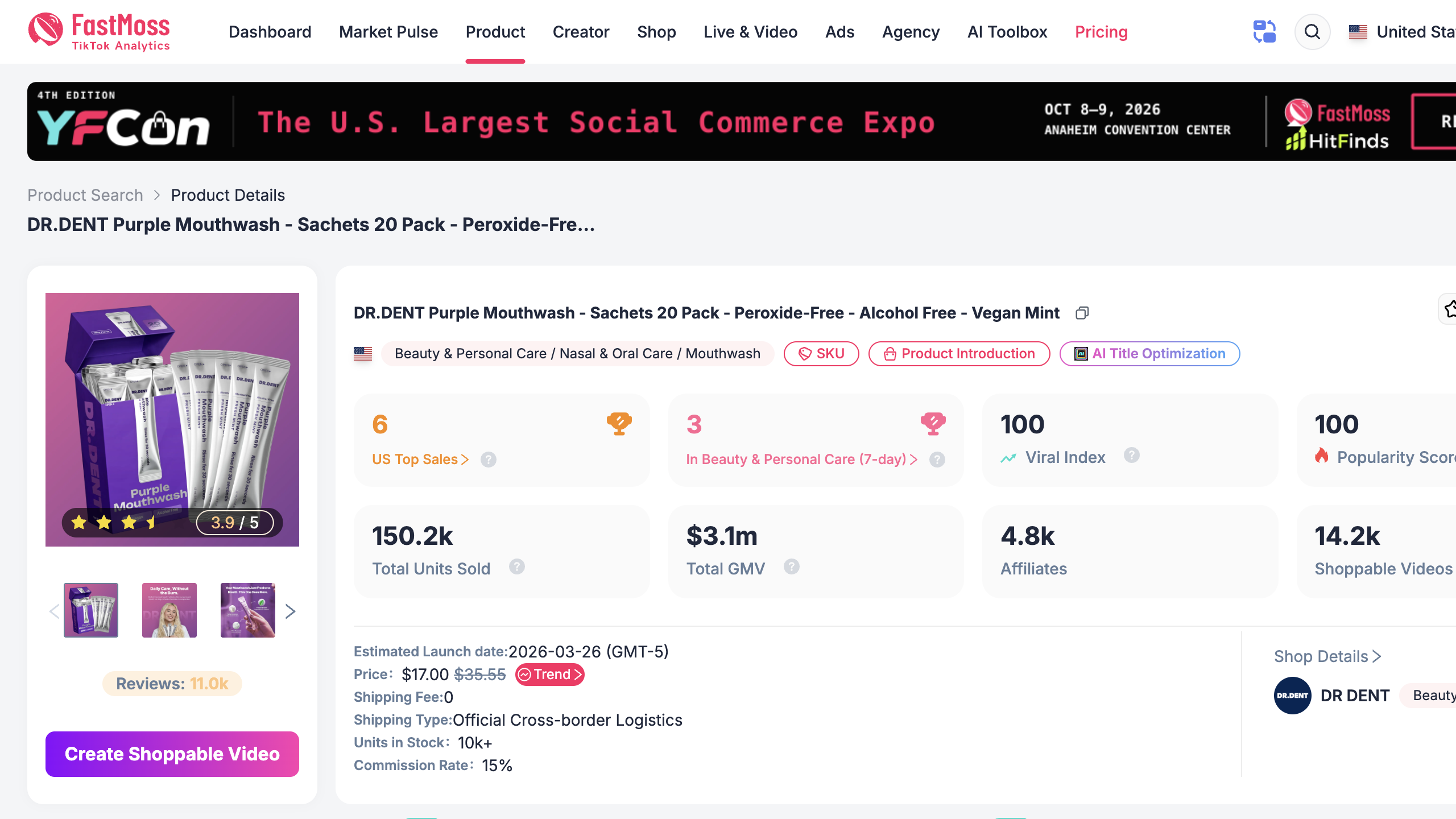
The 28-day distribution view showed:
-
86% of units driven by creators ;
-
80% of units attributed to video ;
-
approximately 79% attributed to paid video traffic ;
-
an estimated ROAS near 4.49 ;
-
thousands of related ad creatives.
The visible rating stayed near 3.9/5. Comment evidence raised questions about effect duration and advertising claims. FastMoss had surfaced a strong opportunity signal and the conditions required to reproduce it.
Floatboat turned those conditions into a management decision:
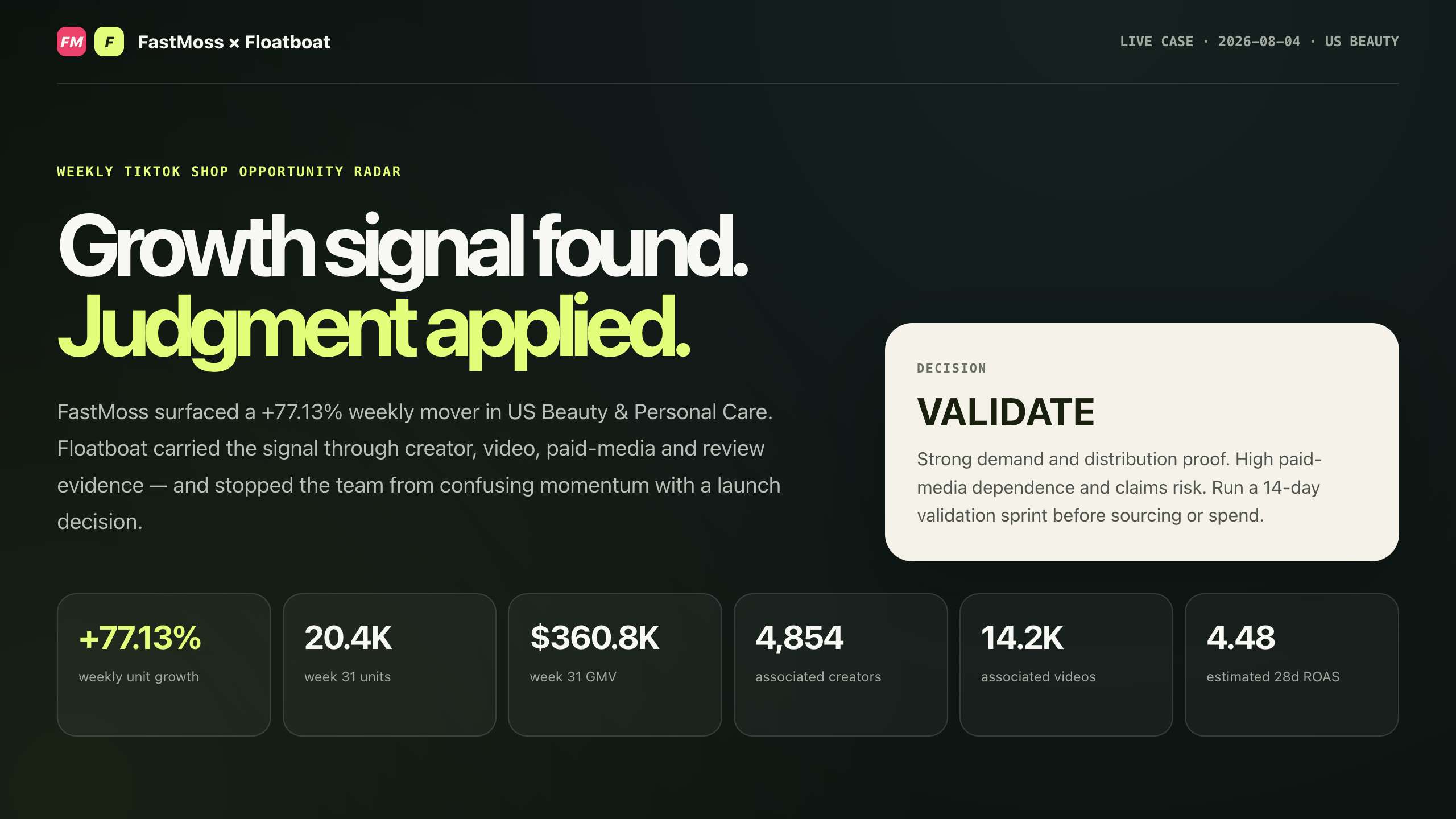
VALIDATE — strong distribution evidence, high paid-traffic dependence, and meaningful claim risk. Confidence: 83%.
The product entered a 14-day validation queue. The recommendation did not become “buy” merely because the growth number was spectacular. That is the difference between collecting data and operating an intelligence function.
Every click became durable business memory
When Floatboat finished browsing, the work did not disappear into tab history or a chat transcript.
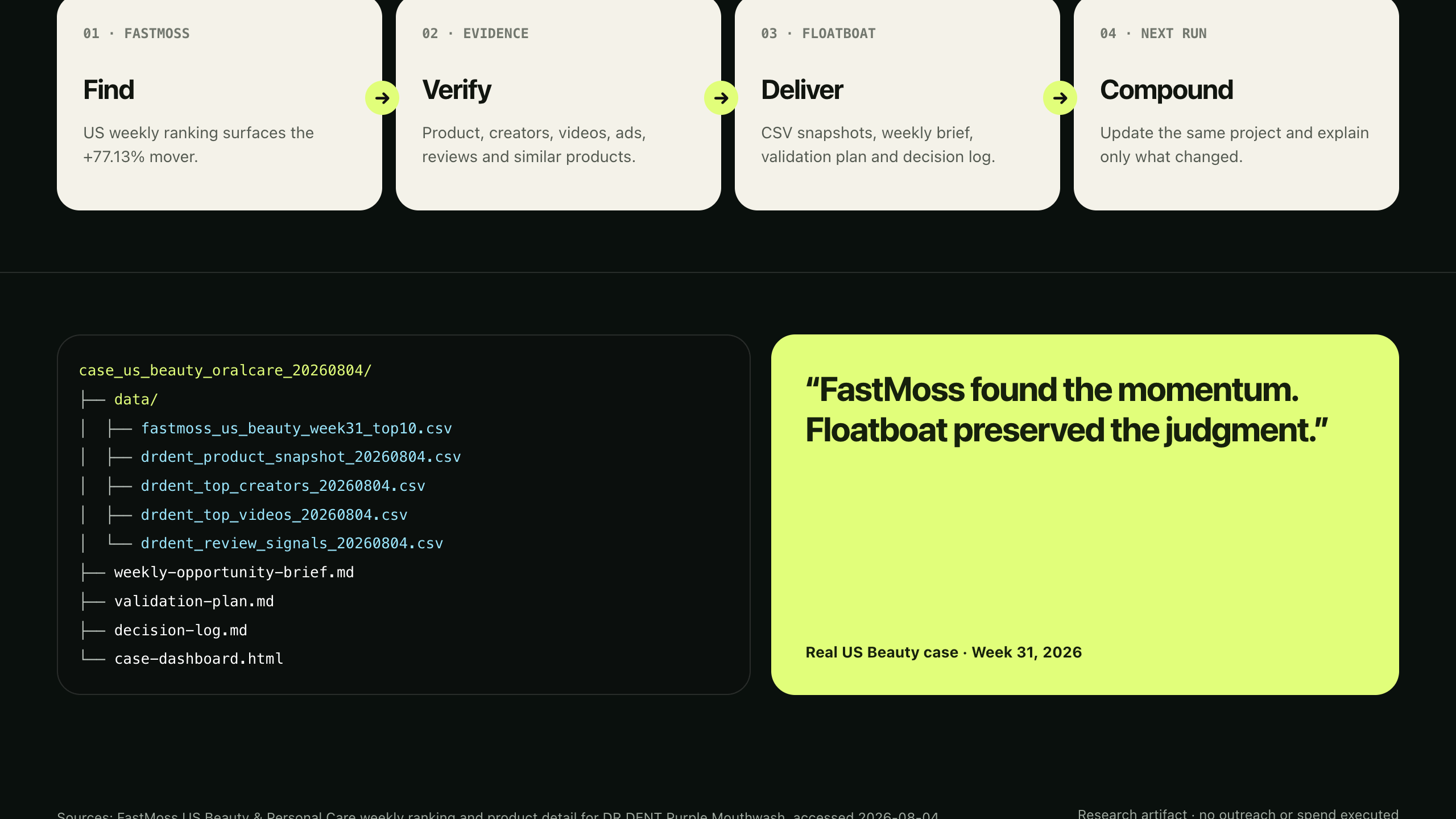
The DR.DENT cycle left 20 auditable files in one dated project run, including:
-
seven live source screenshots;
-
structured live-evidence records;
-
a historical baseline and metric-level comparison;
-
a Markdown management brief;
-
a rendered HTML management brief;
-
the decision recommendation and confidence;
-
a run manifest and execution log;
-
a self-review record;
-
a management email draft;
-
a checksum inventory of the final package.
US Beauty Intelligence/
├── runs/2026-08-05/
│ ├── sources-and-screenshots/
│ ├── live-evidence.json
│ ├── historical-comparison.csv
│ ├── management-brief.md
│ ├── management-brief.html
│ ├── self-review.md
│ ├── email-draft.md
│ └── run-manifest.json
├── decision-log/
├── validation-queue/
├── report-templates/
└── automation-rules/
That directory is more than storage. It is the desk's working memory.
Next Monday, Floatboat knows what the team knew last Monday: which product was under validation, which assumptions remained unresolved, which metric changes matter, what recommendation was made, and when the decision should be revisited. The files can also feed meetings, emails, partner updates, audits, and future models without another copy-and-paste cycle.
Then Floatboat opened its own report
Writing the brief was not the end of the assignment.
Floatboat rendered the management report as a local web page and opened it in the same built-in browser. It verified the title, the recommendation, the 78.88% paid-dependency figure, the comparison table, the embedded evidence, seven links, responsive width, and browser console. The report passed the review and remained attached to the same run manifest as the source evidence.
This closes a loop that ordinary AI writing tools leave open:
Source page → extracted evidence → analysis → report file → rendered inspection → corrected source → approved delivery
The Agent can see both the source and the thing it produced. It can return to either side until they agree.
The report leaves the workspace, while the context stays
After self-review, connected services become the delivery layer.
Under the team's approved policy, Floatboat can prepare or send the management email, include the report link and evidence summary, create the 14-day validation review, place a decision meeting on the calendar, and notify the responsible operator. The recipient gets a concise outcome. The full evidence chain stays in the project.
External commitments remain explicit: creator outreach, public publishing, sourcing orders, pricing or contract changes, advertising budget, and regulated claims can continue to require human approval. Floatboat performs the research and prepares the decision surface; the organization keeps authority over consequential commitments.
Next Monday starts with history, not a blank prompt
At the next scheduled run, Floatboat returns to the same operating state.
It revisits the ranking, captures the new date, reopens DR.DENT and the validation queue, and compares the new values with the prior evidence. The report can focus on deltas:
-
Did weekly rank, units, or GMV materially change?
-
Is paid-video dependency rising or falling?
-
Did the creator network broaden or concentrate?
-
Are ratings, comments, or claim risks deteriorating?
-
Did the product cross a decision threshold?
If nothing important changed, Floatboat can archive the run and deliver a short exception note. If a threshold is crossed, it can expand the investigation. If the web page changes, the run log and screenshot reveal exactly where the operating procedure needs repair.
The workflow can then be packaged as a reusable Workflow or Combo Skill: browser path, evidence schema, scoring rules, folder structure, report template, review checks, approval boundaries, and delivery policy. A new country, category, client, or product line becomes another configured desk rather than another improvised research project.
The larger capability hiding inside this case
The FastMoss case is one vertical example of a broader runtime architecture:
-
The built-in browser is action. Floatboat can work inside the same authorized web software a human uses, including dynamic interfaces that have no convenient integration yet.
-
The file system is continuity. Sources, intermediate work, final outputs, decisions, and failures survive the conversation and remain inspectable.
-
Models and tools are the analysis team. They compare states, detect contradictions, calculate changes, draft recommendations, and transform evidence into different deliverables.
-
FloatSchedule is time. It starts the work with context attached, allowing the same Agent operation to return on a business rhythm.
-
Email, calendar, and connected services are reach. The work can enter management, collaboration, and follow-up systems instead of ending in a chat response.
-
Workflows and Combo Skills are institutional memory. Once a reliable operating pattern is learned, it can be packaged, reused, improved, and distributed.
Together, these layers create something much larger than an AI research assistant. They create a persistent digital operating function that can enter software, manipulate information, produce durable artifacts, inspect its own output, deliver the result, and return when the business needs it again.
FastMoss supplies the vertical commerce intelligence. Floatboat gives that intelligence hands, memory, judgment, a delivery system, and a clock.
What teams can build next
The same pattern can support:
-
a multi-market TikTok Shop category radar;
-
a daily competitor and shop movement monitor;
-
creator discovery with evidence-backed outreach queues;
-
paid-content and creative-pattern intelligence;
-
product validation programs with dated decision gates;
-
weekly client intelligence reports for agencies;
-
a management exception desk that only escalates meaningful changes;
-
bilingual partner reports generated from the same evidence package.
The value compounds because every run leaves the next run better prepared.
Data and editorial note
The live evidence in this article was captured from FastMoss on August 4–5, 2026 and covers the US Beauty & Personal Care Week 31 ranking plus the DR.DENT product detail. FastMoss figures are third-party estimates and can change. Account-restricted fields may vary. The recommendation shown here is an intelligence and workflow example, not product, dental, legal, advertising, sourcing, or investment advice.
Sources
Frequently Asked Questions
Does this require a FastMoss API or MCP connection?
Does Floatboat verify the report it produces?
What is the difference between FloatSchedule and a reminder?
Where do the research outputs live?
Can Floatboat send the report by email?
What still requires human approval?
https://floatboat.ai/blog/automate-tiktok-shop-research-fastmoss-floatboat