Gemini 3.8 Flash — Google's New Coding & Agent Workhorse
Gemini 3.8 Flash is Google's new coding-and-agent workhorse: DeepSWE 73.7%, a 1M context, and a gated Cyber twin. How to use it in Floatboat with zero setup.
TL;DR
-
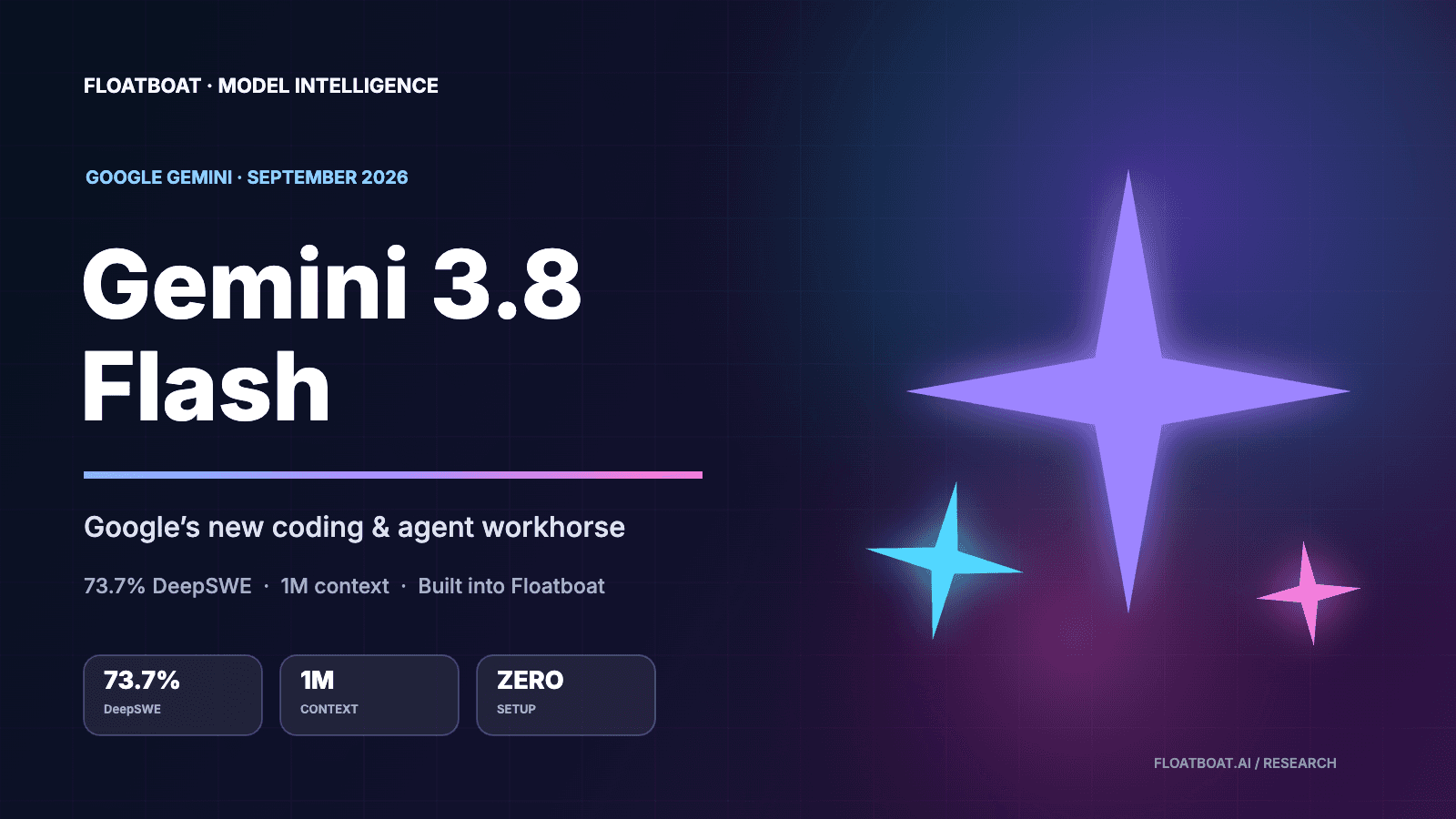
Gemini 3.8 Flash is Google's general-purpose Flash model, released September 2, 2026 as a GA workhorse that matches or beats much costlier models on long-horizon coding and specialized reasoning — scoring 73.7% on DeepSWE v1.1 — while keeping the familiar $0.75/$3.75 per-million-token price through year-end.
-
It is the third Flash release in six weeks and lands three weeks after Gemini 3.7 Flash, while Google's frontier-tier Pro line stays quiet — a signal that for a growing share of real workloads, frontier-level capability is now a Flash feature.
-
On Google's numbers, 3.8 Flash gains more than eight points over 3.7 Flash on DeepSWE v1.1, and independent trackers place it at the top of its price band — but it still trails frontier models on computer use and open-ended agent orchestration, and its "works harder" design raises cost per task by roughly 40 percent at high effort.
-
A second, restricted variant — Gemini 3.8 Flash Cyber — is available only to vetted defenders through Google's new Fairwind Program, so most readers will never touch it; the benchmark halo it creates is still relevant to anyone choosing 3.8 Flash for code review or agentic work.
-
For solopreneurs, the practical question isn't "is it the smartest model ever" but "which jobs deserve the extra reasoning tokens 3.8 Flash spends, and which are still fine on 3.7 Flash" — this article maps the benchmark picture to that decision.
1. Why Gemini 3.8 Flash Matters Right Now
The launch that matters most for solo builders in September 2026 isn't a new frontier flagship — it's Google's third budget-class Flash model in six weeks. Released September 2, Gemini 3.8 Flash arrives just three weeks after Gemini 3.7 Flash (August 13) and extends a cadence that has quietly made the Flash line the most reliable source of model improvement this year. If you pick models for coding agents, client deliverables, or automated workflows, the release rhythm itself is now part of your cost calculus: you can wait for the next Pro-tier giant, or you can ride a stream of Flash upgrades that keep arriving on roughly a monthly beat.
That cadence matters because it is happening inside a curious gap. Ars Technica notes in its coverage of the release that Google has not shipped a frontier-level Gemini Pro model since early 2026, and frames 3.8 Flash as making a delayed Gemini 3.5 Pro even less likely to appear; The Decoder's coverage of the launch similarly headlines the release as arriving "while frontier models remain MIA," naming both 3.5 Pro and Gemini 4 as absent. CNBC's coverage describes the launch as Google's attempt to rebuild AI momentum after its longest monthly stock losing streak since 2015, quoting an analyst who still calls Google "a distant third" in the enterprise AI market. None of that commentary is official Google fact — it is market context — but it explains why Google is leaning on Flash releases to carry its "best reasoning and coding model yet" claim.
For a solopreneur, the strategic read is more useful than the stock chart. When a lab iterates a workhorse model every few weeks instead of hoarding capability for an annual flagship, the efficient buyer stops anchoring on "the best model in the world" and starts tracking the frontier-per-dollar line that moves most quickly. Google's own framing supports this: the launch post describes 3.8 Flash as its "most intelligent workhorse model," and DeepMind leadership has publicly argued that Gemini can increasingly act as a coordinating layer above cheaper, specialized models — a stance CNBC relayed in its launch-day coverage. Whether or not you buy that vision, the pattern is undeniable — capability that cost frontier prices in 2025 is now being sold at $0.75 per million input tokens.
If this is your first time following the Flash line, the natural starting point is our earlier breakdown of Gemini 3.7 Flash's launch, which this release directly succeeds. The rest of this article assumes you already know roughly how a Flash-tier model behaves and focuses on what 3.8 actually changes: the specification, the benchmark reality, the curious cybersecurity twin, and where you can run it without any API plumbing.
2. What Gemini 3.8 Flash Is — and How It Works
Gemini 3.8 Flash is a generally available (GA) workhorse model built for long-horizon software engineering, agentic tasks, and multi-step reasoning in specialized domains — the successor to Gemini 3.7 Flash, with the same speed, context, and introductory price but measurably more diligence on hard problems. Google frames its gains not as raw parameter-scale but as a behavioral change: the model "works harder." On complex tasks it executes extra reasoning steps and calls tools iteratively, and at higher effort levels it will deliberately consume more tokens to maximize performance. That single design decision — trading tokens for accuracy on demand — is the thread that explains nearly every number in this article, including the price increase on the horizon.
The specification is otherwise familiar to anyone who has used 3.7 Flash. The table below consolidates the official details from Google's developer documentation and the launch announcement.
Spec | Gemini 3.8 Flash | Gemini 3.7 Flash (for reference) |
|---|---|---|
Launch stage | GA (September 2, 2026) | GA |
Context window | 1,048,576 tokens (1M) | 1,048,576 tokens |
Maximum output | 65,536 tokens | 65,536 tokens |
Input / output | Text, image, audio, video → text | Text, image, audio, video → text |
Thinking levels | LOW / MEDIUM / HIGH (default MEDIUM) | LOW / MEDIUM / HIGH |
Knowledge cutoff | March 2026 (some domains January 2025 baseline) | — |
Intro price (to Dec 31, 2026) | $0.75 / $3.75 per 1M in/out tokens | $0.75 / $3.75 per 1M in/out tokens |
Standard price (from Jan 1, 2027) | $1.50 / $7.50 per 1M in/out tokens | — |
Three things in that table deserve more than a glance. First, the 1M-token context is not a marketing artifact — at roughly 1,500 pages of text, it is what lets a single agent run ingest an entire codebase or a year of client documentation before answering, which is precisely the shape of task that used to require chunking strategies and manual retrieval. Second, the knowledge cutoff is deliberately worded: Google says training data runs to March 2026 "for some domains," while other domains still reflect a January 2025 baseline — 9to5Google's launch-day coverage flagged that nuance, so do not assume the model knows everything published this spring. Third, the price is an introductory discount shared with 3.7 Flash, and it expires on December 31, 2026, after which both tiers double to $1.50 and $7.50 per million tokens; for scale, that still leaves 3.8 Flash far cheaper than the frontier flagships it competes with on benchmarks — Claude Opus 5 lists at $5/$25 and GPT-5.6 Sol at $4/$20 per million tokens, The Decoder notes.
The "works harder" mechanism is where 3.8 diverges from its predecessor in a way that affects your wallet rather than your prompt. Google explains that gains come from extra reasoning steps and iterative tool calls, and it is explicit that the model may use more tokens "especially at higher effort levels." That is why the model ships with LOW, MEDIUM, and HIGH thinking levels and defaults to MEDIUM: the effort dial is the real cost control. For efficiency-first workloads, Google's own guidance is to use a lower effort level — or keep using 3.7 Flash, which remains fully supported. In other words, Google has outsourced part of the model-selection decision to an effort slider, and the correct setting depends on the job, not on which model you admire.
Access is broad and mostly free to experiment with. Developers get Gemini 3.8 Flash through the Gemini API via Google AI Studio and Android Studio, through Google's agent-first Antigravity environment, and through Stitch for UI generation; enterprises see it in Gemini Enterprise; consumers with Google AI Pro or Ultra reach it in the Gemini app, AI Mode in Google Search, and Gemini in Google Sheets. For builders this matters in one specific way: you can validate the model's output quality in AI Studio for free before you commit a single line of production code — and, as we will see in section 5, you can also reach it inside a desktop agent without owning an API key at all.
3. Coding and Reasoning: Official Benchmarks vs. Independent Reality
Google's launch chart paints Gemini 3.8 Flash as the best coding model in the Flash line and a genuine threat to far more expensive frontier systems; the question for a solo builder is how much of that picture survives contact with independent testing. The honest summary is that the big-ticket claims mostly hold, the "works harder" token tax is real, and two specific frontier gaps — computer use and open-ended agent orchestration — remain wide enough that you should not treat 3.8 Flash as a Claude Opus replacement for every job.
The table below shows Google's reported comparison against Gemini 3.7 Flash, Claude Opus 5, and GPT-5.6 Sol, as reproduced across multiple outlets from the launch chart. Read it in two halves: the top half is where 3.8 Flash wins or ties at a fraction of the price, and the bottom half is where the frontier flagships still earn their higher prices.
Benchmark | 3.8 Flash | 3.7 Flash | Claude Opus 5 | GPT-5.6 Sol |
|---|---|---|---|---|
DeepSWE v1.1 (long-horizon software engineering) | 73.7% | 65.3% | 74.0% | 72.7% |
HLE-Verified (expert reasoning) | 54.9% | 53.6% | 54.4% | 54.5% |
Vals Finance Agent v2 | 61.4% | 59.0% | 58.6% | 53.8% |
Harvey's Legal Agent Benchmark | 10.0% | 8.8% | 6.7% | 2.5% |
Terminal-Bench 2.1 (agentic terminal coding) | 89.4% | 85.8% | 89.1% | 88.8% |
Terminal-Bench 4.0 (general agent capabilities) | 19.1% | 11.2% | 51.8% | 37.3% |
OSWorld-2.0 (agentic computer use) | 59.0% | 50.6% | 75.4% | 62.6% |
GDPVal-AA v2 (knowledge work, Elo) | 1545 | 1482 | 1824 | 1710 |
These are Google's runs under Google's methodology, and as with any release-day chart, independent replication was still pending at launch, as Google's launch post acknowledges — a caveat that matters less for the relative 3.8-vs-3.7 deltas, which are large enough to be structural. On DeepSWE v1.1, Google's reported 73.7% lands essentially level with Claude Opus 5's 74.0% and ahead of GPT-5.6 Sol's 72.7%, while blowing past 3.7 Flash's 65.3% by more than eight points; Google's own launch post claims the model "outperforms most larger frontier models" on the benchmark "at a fraction of the cost." Independent checks lean the same direction: The Decoder and several reviewers put 3.8 Flash at the top of the DeepSWE leaderboard in its price tier, with its 73.7% effectively level with Opus 5's 74.0% on Google's chart. On the professional side, the model leads both frontier flagships on Vals Finance Agent v2 and Harvey's Legal Agent Benchmark and posts a 54.9% on HLE-Verified — a genuinely strong profile for a model sold at Flash prices.
The independent yardstick worth memorizing is the Artificial Analysis Intelligence Index, which does not depend on Google's chart. It scores Gemini 3.8 Flash at 59 at high effort, 57 at medium, and 52 at low, against 56 for the previous 3.7 Flash, per the index's release listing — three points up at the top of the dial — and places high-effort 3.8 Flash level with GPT-5.6 Sol and Grok 4.6, both also at 59, which is the peer group you should actually compare it to, per The Decoder's chart. On cost per task, though, the picture is double-edged: at high effort the model lands at about $0.58 per task, roughly 40 percent above 3.7 Flash's $0.40, even though the per-token price is identical — a direct, quantified consequence of "works harder." The model still sits on the Pareto frontier (cheapest model at its intelligence level), but the frontier moved up along the cost axis, not just the quality axis.
Now the honest gaps, because they are exactly where over-optimistic coverage misleads solo buyers. On OSWorld-2.0 computer use, Gemini 3.8 Flash scores 59.0% against Claude Opus 5's 75.4% — Google's models have historically struggled here, and Ars Technica notes 3.8 remains "far behind" the market leader even after improving on 3.7 Flash. On Terminal-Bench 4.0, which measures general agent capability rather than scripted tool use, the gap is even starker: 19.1% for 3.8 Flash versus 51.8% for Opus 5. And on GDPVal-AA v2's knowledge-work Elo, the flagship lead is 1824 to 1545 — meaningful when a job rewards raw breadth. Meanwhile, the same "works harder" mechanism that buys accuracy also makes efficiency-sensitive users the losers if they leave the dial high, which is exactly why Google tells compute-constrained teams to stay on 3.7 Flash or drop to a lower effort level.
Put the two sides together and the practical rule for solopreneurs becomes a decision rule rather than a verdict. For a long coding sprint where a 73%-grade autonomous engineer would save you hours, 3.8 Flash at MEDIUM or HIGH is the right tool and beats paying Opus prices for it. For repetitive high-volume work — the same weekly report, the same boilerplate extraction, the same follow-up email — the extra reasoning tokens are pure waste, and 3.7 Flash (or a lower thinking level) is the smarter default. The mistake to avoid is treating "better benchmark average" as "better for my workload"; with effort-based pricing, model choice and effort choice are the same decision, and they should both follow the job.
4. Gemini 3.8 Flash Cyber and the Fairwind Program
Alongside the general-purpose model, Google shipped Gemini 3.8 Flash Cyber — a version of the same foundation tuned for vulnerability discovery and automated patching — and almost nobody will get to use it. Access runs exclusively through the Fairwind Program, Google's limited-access initiative for government cyber authorities, critical infrastructure operators, and maintainers of widely used software. Google says it already works with more than 650 such partners globally, according to the Fairwind Program's page; participants pair 3.8 Flash Cyber with the CodeMender harness, which finds vulnerabilities, validates candidate fixes, and generates deployment-ready patches inside the organization's own secure cloud environment.
The reason for the gate is deliberate and worth understanding even for readers who will never hold a Fairwind badge. Because defensive cyber work requires acting on exploit paths that a consumer model would be trained to refuse, 3.8 Flash Cyber ships with more permissive mitigations than the standard model — and Google therefore restricts it to trusted defenders rather than offering it publicly. That follows the tiered-access pattern Anthropic and OpenAI now apply to their most capable security models, Security Boulevard notes, and it means the standard 3.8 Flash you can actually call has stricter guardrails than the cyber twin that powers the headlines. If you are evaluating 3.8 Flash for code review or security tooling on your own projects, you are getting the constrained version — which for most solo work is the safer and sufficient one.
Cyber benchmark | Gemini 3.8 Flash Cyber | Comparison |
|---|---|---|
CyberGym (vulnerability discovery) | 86.2% | 3.5 Flash Cyber 77.5%; GPT-5.6 Sol 83.6% |
CWE-Bench pass@1 (automated patching, run by Collinear) | 47.2% | Leading frontier model 47.8% |
Internal 20-language vulnerability benchmark | >70% success | "Impressive leap" over previous models |
Chrome real-world patches | 2.6x more correct patches | vs. much larger best commercial models |
Wiz penetration-testing benchmark | +7.5–9.7% recall | at 2.3–5.2x lower cost |
Google Cloud Vulnerability Research | critical foundational bug in <2 hours | research of this class usually takes months |
Google's CyberGym figure of 86.2% and the CWE-Bench pass@1 of 47.2% are both reported by Google and echoed by independent coverage, with The Decoder's write-up adding that 3.8 Flash Cyber lands on the Pareto frontier for patching — nearly matching the best frontier model's 47.8% pass@1 while costing far less. The real-world numbers are the more striking ones because they come from deployment rather than a benchmark suite: Google's Chrome Security team measured 2.6x more correct patches than much larger commercial models, security firm Wiz measured a 7.5–9.7 percentage-point recall gain at a fraction of the cost, and Google's Cloud Vulnerability Research team reports finding a critical foundational vulnerability in under two hours — work that normally takes months, the launch post details.
For a solopreneur, section 4 is mostly context, but it is not useless context. The existence of a frontier-grade cyber twin signals that Google is training the shared Flash foundation partly on demanding security code, which is one reason the standard model's code review and vulnerability-spotting behavior improved alongside its general coding scores; the launch post credits "rigorous training in the highly demanding domain of cybersecurity" for gains across the shared core. It is also a reminder that model capability and model access are diverging as product decisions — the most capable models are increasingly the least available ones. When you choose a model for your own agent stack, you are implicitly accepting whatever access and safety policy ships with it, which is one more argument for routing through a layer that keeps multiple models interchangeable rather than betting your whole workflow on a single vendor's gating decisions.
5. Why Built-In Matters — Gemini 3.8 Flash in Floatboat
Gemini 3.8 Flash is already built into Floatboat. It sits in the model picker beside DeepSeek, MiniMax, GLM, Kimi, Claude, and the GPT-5 family, with no API key to request and no router or proxy to configure — which is exactly what Floatboat's "All Frontier Models, Zero Setup" pillar promises. A Google launch day therefore becomes a picker update, not a migration project: open any event's model list and Gemini 3.8 Flash is selectable for that task immediately, while the event's agent workspace keeps its context even when you switch models mid-run.
Which jobs should get the extra reasoning tokens? A long coding sprint is the high-effort case: let 3.8 Flash iterate on a pull request or script until it is right, because that is where the DeepSWE gains over 3.7 Flash pay rent. Meeting preparation and client briefs suit the 1M-token context at medium effort — the agent reads the whole thread and the past deliverables instead of chunking them. Routine follow-ups and recurring automations belong on 3.7 Flash or a low effort level, since the extra tokens would be pure waste. We describe the underlying calendar-as-runtime pattern — agents that prep before events and follow up after — in our explainer of the agentic calendar; this section just adds the model-selection layer on top of it.
Built-in changes three practical things for a solo founder. Per-event model choice means you are never locked to one vendor per workflow. No infrastructure means there is no monthly API bill and no routing logic to maintain when Google's pricing changes in January. And because effort is now the real cost lever on 3.8 Flash, seeing the model list beside each event makes the cost decision legible in a way an API console never will. If the alternative is wiring three separate API accounts into a custom agent loop, the difference is not convenience — it is the gap between trying Gemini 3.8 Flash this week and trying it someday.
6. Conclusion
The most useful way to read Gemini 3.8 Flash is not as another round of benchmark inflation but as the clearest statement yet of where model economics are heading: Google is selling near-frontier coding and reasoning at workhorse prices and letting the effort dial, not the model tier, govern what each task costs. For solo founders the takeaways are practical. Use 3.8 Flash at medium or high effort for long-horizon coding and anything where a wrong draft costs you hours; keep 3.7 Flash or low-effort settings for the volume work where extra reasoning tokens are pure expense; do not expect 3.8 to fix computer-use automation, where Claude Opus 5 remains in a different class; and treat the gated Cyber twin as a signpost about where the shared foundation is trained, not as a model you will ever call directly. The decision framework that survives all the release-day noise is a simple one — match effort to error cost, not to headline scores — and it is exactly the kind of judgment a calendar-driven agent stack, with its model picker and per-event workspaces, is built to let you exercise.
Frequently Asked Questions
Is Gemini 3.8 Flash better than Claude Opus 5 or GPT-5.6 Sol?
Gemini 3.8 Flash vs. Gemini 3.7 Flash — which should I use?
Why does the price go up to $1.50/$7.50 in January 2027?
Who can actually use Gemini 3.8 Flash Cyber?
Does Floatboat already include Gemini 3.8 Flash?
What should solo founders use Gemini 3.8 Flash for?
https://floatboat.ai/blog/gemini-3-8-flash