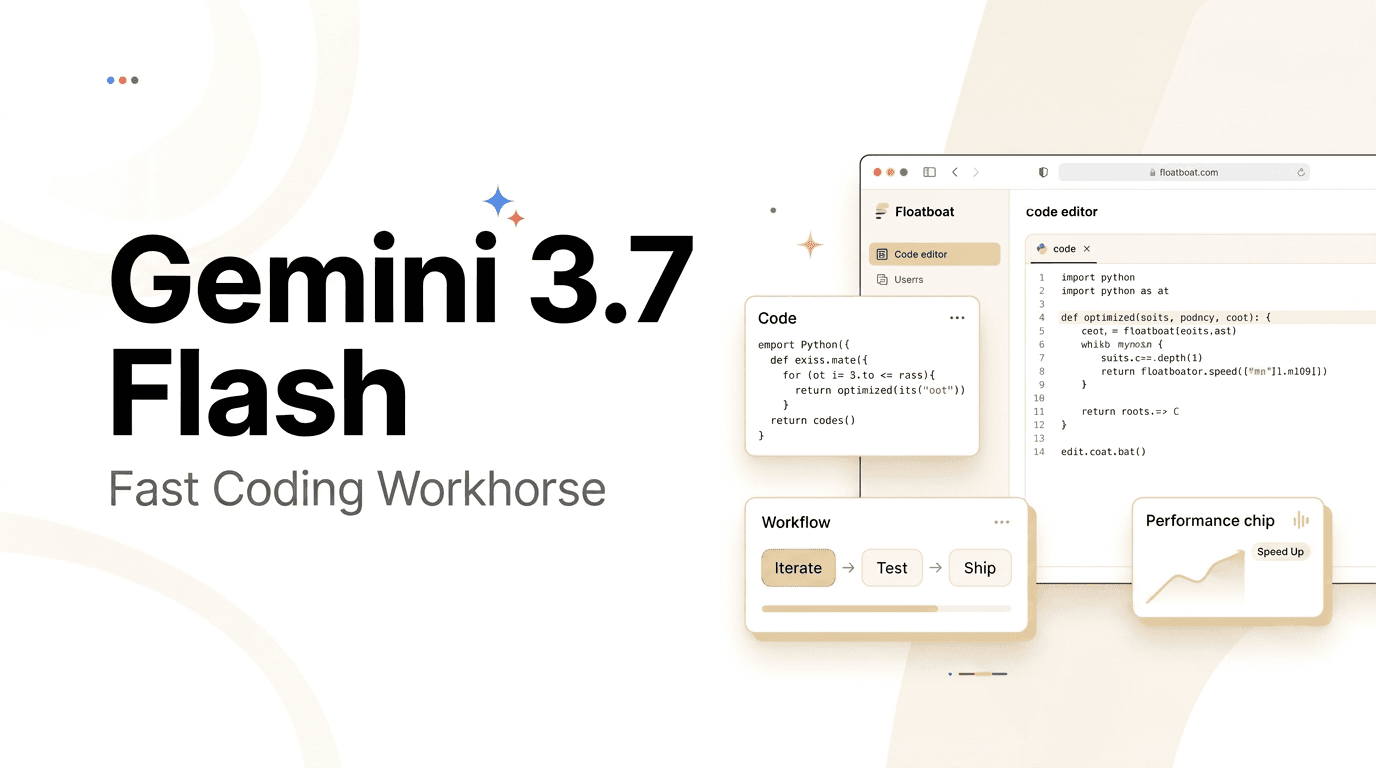
Gemini 3.7 Flash — Three-Week Iteration, Real Coding Gains, Now in Floatboat
Gemini 3.7 Flash ships three weeks after 3.6 Flash with a 50% introductory price cut and real coding gains. Benchmarks, the January price trap, and built-in access.
TL;DR
- Gemini 3.7 Flash, released August 13, 2026, is Google's third Flash-tier model in three months — an algorithmic refinement of 3.6 Flash rather than a new base model. It delivers its largest gains on software engineering and web development: FrontierCode 1.1 Main climbs from 34.4% to 43.6%, DeepSWE v1.1 from 49.0% to 65.3%, and WebDev Arena Elo from 1,538 to 1,588, per Google's announcement. These are Google-reported results; Artificial Analysis independently scores it 56 on its Intelligence Index at high reasoning, four points above 3.6 Flash.
- The strongest claim is price-to-performance. At $0.75 per million input tokens and $3.75 per million output tokens through December 31, 2026 — half the original 3.6 Flash rate — the model combines frontier-tier coding with roughly three times the output speed of GPT-5.6 Terra and GLM-5.2, placing it on the Pareto frontier of intelligence versus time per task. Those promotional rates double on January 1, 2027, to $1.50/$7.50.
- The release is a direct response to developer backlash against 3.6 Flash — frontend code generation regressed, and it lagged Cursor's Composer 2.5 on CursorBench. Google addressed the specific failures with algorithmic improvements to the reasoning foundation rather than an architectural rebuild, and the response is widely read as damage control that delivered.
- Gemini 3.7 Flash is already built into Floatboat — no API key, no routing layer, no configuration. It appears in the model roster alongside DeepSeek, GLM, Kimi, Claude, and MiniMax, ready for agent pipelines that need a fast, capable workhorse for coding and knowledge work.
1. Three Weeks Between Models — the Cadence That Changed Developer Expectations
The most unusual fact about Gemini 3.7 Flash is not its benchmark table. It is the date on the announcement: August 13, 2026 — three weeks after Gemini 3.6 Flash, which was itself released three weeks before that, as Ars Technica noted. Google has effectively moved to a monthly release cadence for its workhorse tier, and the developer response has been a mixture of appreciation and fatigue. Appreciation, because each release has brought measurable gains. Fatigue, because every three weeks another migration question arrives: does the new model change my agent's behavior, does the API change, do I need to re-tune my prompts?
The version fatigue is not hypothetical. When 3.6 Flash shipped in late July, developers immediately pushed back: frontend code generation had regressed, the model barely matched the older 3.5 Flash on composite benchmarks, and it lagged behind Cursor's native Composer 2.5 on CursorBench, as byteiota's launch-day analysis documented. The criticism was specific enough that Google's 3.7 Flash launch reads as a direct answer to it — a "substantial improvements" release that addresses the exact failures the community complained about. Google says the gains come from algorithmic improvements to the model's reasoning foundation, not an architectural rebuild, and the timing is a consequence of developer feedback feeding directly into the next iteration.
The broader context explains the urgency. Google's flagship Pro model remains missing: Gemini 3.5 Pro, promised for June and repeatedly delayed, has not shipped, and Google's own benchmark table shows its coding capability has been under pressure from every direction — Anthropic's Claude Fable 5 at the top, OpenAI's GPT-5.6 family close behind, and an accelerating field of open-weight models from China. The Flash line has become the vehicle for staying competitive while the Pro line sorts itself out. For developers, that means the workhorse tier is where the action is — which is exactly where Floatboat's built-in model roster lives.
2. What Gemini 3.7 Flash Is — a Refined Workhorse, Not a New Base
Gemini 3.7 Flash is a refinement of Gemini 3.6 Flash. The model card is explicit: it is based on Gemini 3.6 Flash, with algorithmic improvements to the core reasoning foundation. It is not a new pretraining run, not a new architecture, and not a scaled-up model. What changed is how the model reasons and plans — Google describes a model that thinks more diligently, adapts better to roadblocks, clarifies intent when needed, and follows instructions with greater fidelity. The developer-facing result is less manual oversight and fewer retries across engineering workflows.
The spec sheet is a 1,048,576-token context window with a maximum of 65,536 output tokens, native multimodal input (text, images, audio, video), and support for structured output, function calling, code execution, and computer-use preview. A notable API change accompanies the release: developers migrating from 3.6 must remove temperature, top_p, and top_k, replace the numeric thinking_budget with a three-tier thinking_level setting (low, medium, high, with medium the default), and drop candidate_count. Low targets latency-sensitive work like incident response; medium balances speed and reasoning for coding and agent workflows; high spends more reasoning tokens on difficult planning and debugging. Because token consumption scales with effort level, thinking_level functions as a price selector in disguise — a team that runs everything at high will silently convert a budget model into a premium one.
The model is available through the Gemini API in Google AI Studio and Android Studio, in Google's Antigravity environment, on the Gemini Enterprise Agent Platform, and — for consumers — inside Gemini Spark for Google AI Pro and Ultra subscribers across 160+ countries. Google has also applied the new introductory rate to 3.6 Flash, so both models share the same price point until the end of the year. There is no open-weight release: Gemini 3.7 Flash is API-only, which means no self-hosting and no air-gapped deployment for teams that need them.
3. Where the Gains Are Real — Coding Benchmarks, Independently Checked
The benchmark story splits into two parts: Google's own numbers, and what independent evaluators confirmed within days of launch. On Google's published table, the largest gains are in long-horizon software engineering. DeepSWE v1.1 rises from 49.0% to 65.3% — ahead of Claude Sonnet 5 (54.0% per Google's table) and within striking distance of GPT-5.6 Terra (69.6%). FrontierCode 1.1 Main, which measures production code quality, climbs from 34.4% to 43.6%, above both Sonnet 5 and GPT-5.6 Terra on Google's figures. WebDev Arena, a blind human-preference benchmark, puts 3.7 Flash at 1,588 Elo — the top score in Google's comparison table, ahead of Sonnet 5 (1,541) and GPT-5.6 Terra (1,523).
The independent picture appeared quickly. Artificial Analysis ran the model across all three reasoning levels within a day of release and scored it 56 on its Intelligence Index at high reasoning — a four-point jump over 3.6 Flash, placing it just behind GPT-5.6 Terra and Meta's Muse Spark 1.2 (both 57) and ahead of Claude Sonnet 5 (55), per OfficeChai's coverage. More striking than the score is the speed: roughly 340 output tokens per second, nearly three times the throughput of GPT-5.6 Terra and GLM-5.2, with an average time per task of 1.7 minutes at high reasoning — about 40% faster than GPT-5.6 Terra needs for comparable intelligence. Plotted against every other model Artificial Analysis tracks, that combination puts Gemini 3.7 Flash on the Pareto frontier of intelligence versus speed. Arena.ai's WebDev leaderboard independently lists 3.7 Flash High at 1,588 Elo after 2,544 votes, confirming the direction of Google's frontend claim, with the caveat that its ±13 Elo interval overlaps neighboring models including GLM 5.2 Max and DeepSeek V4 Flash.
The areas where the model does not lead are just as informative. GPT-5.6 Terra remains ahead on terminal-heavy work (Terminal-bench 2.1 at 87.4% vs 85.8%) and on the hardest long-horizon agents (Terminal-bench 3.0 at 20.8% vs 14.9%, OSWorld-2.0 at 50.2% vs 47.9%). CharXiv Reasoning is a small regression — 84.5% without tools, down from 85.2% for 3.6 Flash. And on GDPval-AA v2, a knowledge-work benchmark, 3.7 Flash scores 1,525 Elo against 1,598 for Sonnet 5 and 1,628 for Muse Spark 1.2. The honest summary: Gemini 3.7 Flash is the best workhorse-tier model for coding agents and web development as of mid-August 2026, with genuinely verified gains, but it is not the strongest model in every category — and the harder the terminal-and-computer-use territory, the more it trails the newest flagship models.
4. The Price Story — Half Off Until January, Then It Doubles
The sharpest argument for Gemini 3.7 Flash is not a benchmark. It is the price: $0.75 per million input tokens and $3.75 per million output tokens through December 31, 2026, with context caching at $0.075, per Google's pricing page. That is half the original 3.6 Flash rate, and roughly a third of the blended cost of Claude Sonnet 5 ($2/$10) or GPT-5.6 Terra ($2/$12). For high-volume coding agents and knowledge-work pipelines, that changes the economics of running a frontier-tier model at scale.
The caveat is that the price is explicitly promotional, and it expires. On January 1, 2027, rates double to $1.50 input and $7.50 output, with caching rising to $0.15. Google has been transparent about this — the model card and every pricing page state it — but the operational implication is easy to miss: any team that builds its agent pipeline's cost model on today's rates will face a 2x increase on the first business day of the year. Agents that carry large context windows or spend more time reasoning (the thinking_level: high habit) will be hit hardest, because both scale with token consumption. The New Stack's coverage makes the point plainly: teams building around today's price should either price their product economics at the January 2027 rate or plan a migration before year-end.
The price war context matters here. OpenAI recently slashed its own API costs — GPT-5.6 Luna now lists at $0.20/$1.20 — amid rising global competition, and DeepSeek V4 Flash undercuts even the introductory Gemini rate at $0.14/$0.28. Google's move is not a market anomaly; it is the market. But the Flash strategy pairs the discount with a release cadence no one else matches: three model drops in three months, each at half the previous price, each with real gains. The combination is a deliberate bid for production workloads — get developers to build agents on Gemini Flash now, at a price that makes the switch trivial, and let the code stay. For a solo founder that is a real consideration, but the honest version is: the price is the hook, the January rate is the product, and the difference between the two is a budget decision you make in October.
5. What Fast Iteration Means for Developers — Migration, Version Fatigue, and the Missing Pro
There is a hidden cost to the three-week cadence that benchmark tables do not capture: migration. Moving from 3.6 Flash to 3.7 Flash is not a drop-in swap. The API changes — removing sampling parameters, replacing thinking_budget with thinking_level, dropping candidate_count, and standardizing multi-turn interaction around server-side previous_interaction_id — require code changes, retesting, and regression checks. Developers on 3.5 Flash or 3.1 Pro face the same list. Google's message is that the changes are manageable and that 3.6 Flash is not being shut down, but the subtext is that version fatigue is real: a developer who just finished integrating and testing 3.6 Flash in early August is being asked to do it again before the month ends.
The version fatigue is compounded by what is missing. Gemini 3.5 Pro was promised for June, then described as "soon," and has still not shipped as of mid-August — Google has reportedly started training Gemini 4. The Flash line has absorbed the pressure, but the absence of a Pro release means developers who wanted a flagship Gemini model have been waiting for months while Flash keeps getting better and cheaper. The pattern is worth reading carefully: the model you are actually offered is not always the model you were promised, and in this cycle the workhorse tier has become the flagship in everything but name. For agent pipelines that need reliability and speed at scale, that is fine. For teams that need the absolute ceiling of reasoning capability, the waiting game continues.
The practical guidance for anyone using Gemini 3.7 Flash in production is to treat the cadence as a feature with a cost. Evaluate each release against your own workloads — the benchmark tables are vendor-reported, and the independent verification only covers the metrics Artificial Analysis chose to run. Use thinking_level deliberately rather than by default. Price your product at the January 2027 rates, not the promotional ones. And keep a canary deployment so that when the next Flash ships in September, you can test it against your real tasks without rewriting your entire stack first.
6. Why Built-In Matters — Gemini 3.7 Flash in Floatboat
For solopreneurs, the practical question about any new model is not "is it good" but "how do I get it into my workflow without becoming an MLOps engineer." That is where the built-in model roster changes the equation. Gemini 3.7 Flash is available inside Floatboat the same way every model in the roster is: no API key, no routing layer, no billing setup, no provider account. Open any agent workspace, open the model selector, and Gemini 3.7 Flash is listed alongside DeepSeek, GLM, Kimi, Claude, and MiniMax — select it, or let Auto Mode route to it when the task profile calls for a fast, capable workhorse.
The workflow mapping is what makes it useful, not the model list. Gemini 3.7 Flash's strengths — high throughput, strong long-context retrieval (97.0% on GDM-MRCR v2 at 128k), improved document comprehension (GDP.pdf up from 22.0% to 34.0%), and a 1M context window that ingests large codebases in a single pass — map directly to calendar-driven agent work. A client strategy review that requires synthesizing months of meeting notes, CRM records, and email threads benefits from the 1M context and the long-context retrieval. A deadline-driven coding sprint that needs rapid iteration across a large repository benefits from the throughput and the discipline Google added to multi-step planning. A knowledge-heavy preparation task benefits from the document gains. The model is the workhorse tier of an agentic calendar system in the same way that premium reasoning models are the deep-thinker tier.
The comparison to other built-in models is worth stating fairly. Gemini 3.7 Flash is not the strongest model in Floatboat's roster on every dimension — for the very hardest multi-hour agentic work, premium models and the newest open-weight flagships like GLM-5.3 (see our GLM-5.3 analysis) remain strong contenders, with the key difference that open-weight models offer self-hosting while Gemini is API-only. What Gemini 3.7 Flash offers that nothing else in the tier matches is the combination of verified coding gains, frontier-tier throughput, and a promotional price that makes high-volume agent runs inexpensive through the end of the year. For a solo operator deciding what to route where, that is a real differentiator — and it is available today with zero setup. If you are new to Floatboat, the setup is the same three steps as always: download the desktop app from floatboat.ai, connect your calendar, and build your first agent pipeline.
7. Conclusion
Gemini 3.7 Flash is the clearest statement yet of Google's workhorse-tier strategy: iterate monthly, ship real gains, cut the price in half, and let distribution do the rest. The model delivers genuinely improved coding capability — verified by independent evaluators, not just Google's charts — at a speed that puts it on the Pareto frontier of intelligence versus time per task, and at an introductory price that makes frontier-tier agent work inexpensive through year-end. It is not the strongest model in every category, the promotional price doubles in January, and the API changes are a migration tax on top of the version-fatigue tax.
The market context gives the release its shape. With Gemini 3.5 Pro still missing and the open-weight field accelerating — GLM-5.3, Grok 4.6, and DeepSeek's V4 family all shipping in the same window — Google is competing on iteration speed and cost rather than on a single flagship benchmark. For developers, the decision framework that emerges is simple: route high-volume coding and knowledge work to a fast workhorse model like Gemini 3.7 Flash, route the hardest multi-hour reasoning to a premium or open-weight flagship, and never build your cost model on a promotional price. The model is the best workhorse tier has offered in years. Just budget for January.
Frequently Asked Questions
Is Gemini 3.7 Flash better than Gemini 3.6 Flash?
How much does Gemini 3.7 Flash cost?
Why does the price double in January?
Is Gemini 3.7 Flash available in Floatboat?
Do I need to change my API code to migrate from 3.6 Flash?
Is Gemini 3.7 Flash open source?
https://floatboat.ai/blog/gemini-3-7-flash