
GLM-5.3 — Post-Training Scaling, Open-Weight Coding, and the Security Surprise
GLM-5.3 keeps GLM-5.2's base and gains ~50% coding through post-training scaling. Terminal-Bench, DeepSWE, the cyber surprise, open weights, pricing, and limits.
TL;DR
-
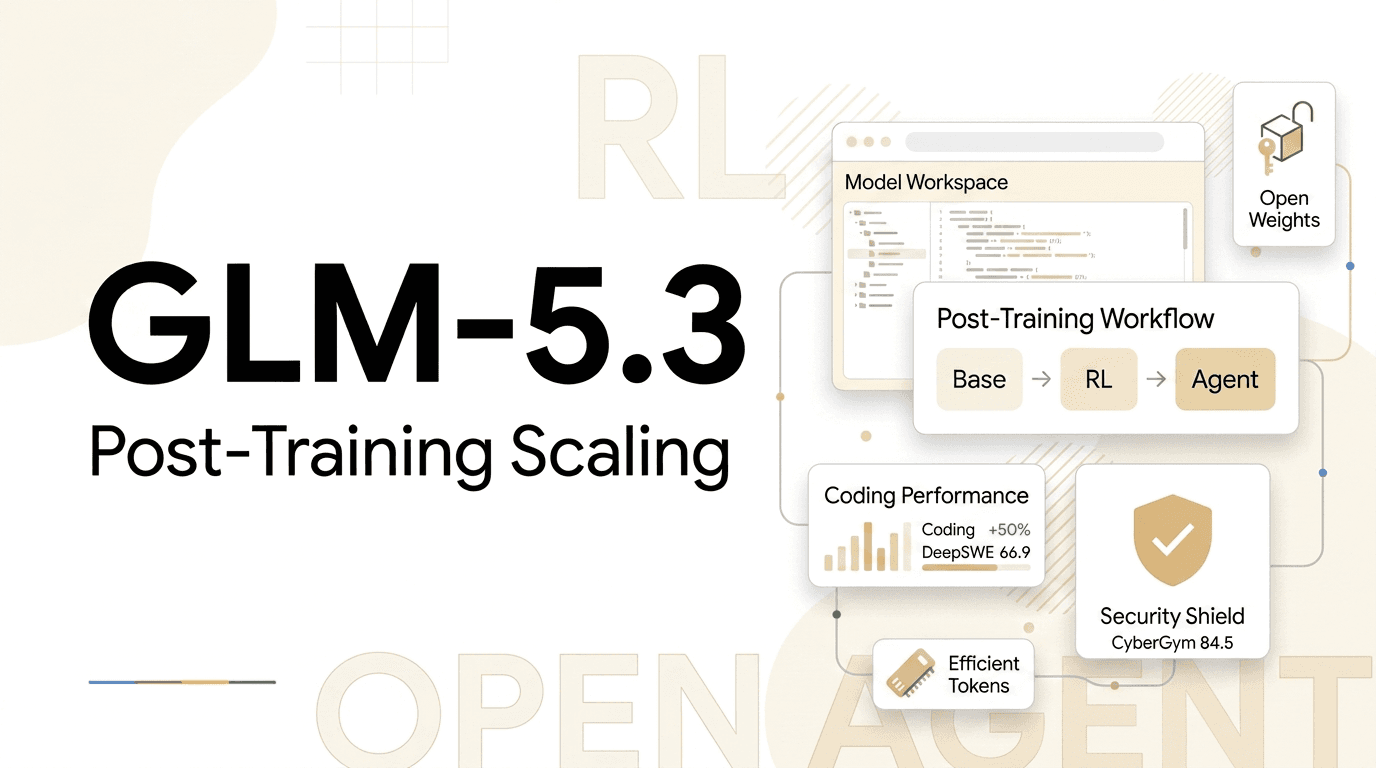
GLM-5.3, released August 14, 2026, reuses the exact ~743-billion-parameter base of GLM-5.2 and gets its entire performance gain from post-training scaling — a live test of whether a base model's intelligence ceiling can be raised without a new pretraining run. Z.ai says the gains come from dozens of times more long-horizon environments, richer environment types, and a much longer post-training run built on its IndexShare, SAO, and Slime reinforcement-learning stack.
-
Coding is the headline. Z.ai reports roughly a 50% internal gain over GLM-5.2 and open-source-first results on Terminal-Bench 3.0 (4.6 → 28.3), DeepSWE v1.1 (46.2 → 66.9), and Agents' Last Exam CLI (23.8 → 28.5), closing most of the measured gap to Claude Fable 5 while staying measurably cheaper per output token than Claude Opus 4.8, per Z.ai's GLM-5.3 release notes.
-
The surprise is cybersecurity. GLM-5.3 scores 84.5% on CyberGym — ahead of Claude Mythos 5 (83.8%) and GPT-5.6 Sol (83.6%), as covered by OfficeChai — a capability Z.ai says it did not deliberately train for. Before the open-weights release it participated in a red-team that found 2,436 vulnerabilities across 269 projects, 1,097 of them medium- or high-severity.
-
Weights open in roughly two weeks (MIT expected, following GLM-5.2). Until then GLM-5.3 runs through the GLM Coding Plan (Lite ¥118 / Pro ¥538 / Max ¥1078 per month) and tools including ZCode, Cursor, Cline, and Claude Code. It is also built into Floatboat's model roster alongside DeepSeek, Kimi, Gemini, Claude, and MiniMax.
1. Why a Point Release with No New Base Model Still Matters
The normal story of a flagship model release is the new pretraining run: more parameters, more data, a bigger architecture, and a benchmark table that shifts accordingly. GLM-5.3 breaks that template. Z.ai explicitly stated that the base model is identical to GLM-5.2's, and that every measurable gain came from the post-training stage — a longer run, a wider variety of environments, and far more long-horizon task data processed through its reinforcement-learning stack, as documented in Z.ai's release announcement. That framing matters beyond the specific numbers, because it tests an assumption the industry has held since the first generation of large models: that a model's intelligence is roughly fixed once pretraining ends, and that fine-tuning can polish behavior but not raise the ceiling.
The evidence for that assumption has been weakening all year. DeepSeek's V4 family improved substantially between versions through post-training investment as well, and the same-week comparison our DeepSeek V4 Pro 0813 analysis documents shows how much of modern model progress now comes from the RL stage rather than from architecture. GLM-5.3 is the most aggressive version of that claim yet, because it deliberately held the architecture fixed and spent months of compute and environment engineering on scaling the post-training phase. The result is a model that beats its own predecessor by large margins on long-horizon tasks without any new pretraining, which raises a practical question for anyone who builds agents: when a lab can squeeze a 50% coding improvement out of the same base, the refresh cycle of model capabilities may no longer be tied to the expensive pretraining schedule.
There is also a market signal buried in the timing. The ZCode website briefly leaked a "ZCode for GLM-5.3" page on August 3, and Zhipu's stock rose more than 8% that day; Goldman Sachs later raised its revenue expectation for the company by 35%, as reported by NetEase Tech. The market reaction is a reminder that in the current cycle, model capability announcements move the value of the companies that ship them, and that open-weight labs are now competing on post-training execution rather than on base-model scale alone.
2. What GLM-5.3 Is — Same Base, Extreme Post-Training
GLM-5.3 is a mixture-of-experts model on the same foundation as GLM-5.2: roughly 743 billion total parameters with a fraction activated per token, and a context window inherited from the GLM-5 family. Z.ai did not change the base, the tokenizer, or the architecture. What it changed is what happened after pretraining. The company's release documentation describes a post-training phase that ran far longer than the previous version's, over a much larger set of simulated task environments — terminals, tool-calling loops, long-running code repositories, and agentic workflows — with the objective of improving task completion rather than next-token accuracy.
The reinforcement-learning infrastructure behind this is worth naming because it explains why the improvement is concentrated where it is. IndexShare handles long-context processing; SAO (the successor to earlier long-horizon RL work) handles reinforcement learning across extended task sequences; and the Slime training framework, which Z.ai open-sourced, orchestrates the pipeline. All three were present in GLM-5.2's post-training. What GLM-5.3 added was scale and variety: more environments, longer episodes, and more compute, all aimed at the same base. The company's own framing — "we may be far from the intelligence ceiling of this base" — is an admission that they do not yet know how much further this particular foundation can be pushed.
One design detail matters for how the model behaves in practice: GLM-5.3 retains the effort-level control introduced with GLM-5.2, letting callers trade reasoning depth against latency and token cost. On Z.ai's internal Code Bench, the company reports that at the high reasoning tier, GLM-5.3 completes 31.5% of end-to-end tasks at an average of roughly 50,000 output tokens — a higher completion rate than Claude Opus 4.8's 29.5%, which needed about 120,000 tokens to achieve, per MarkTechPost's coverage. That is a two-to-one token-efficiency advantage on the same class of task, and for anyone paying per token on long agent runs, it matters as much as the headline completion numbers. As with all vendor-reported results, these figures should be treated as claims until independently reproduced, but the direction of the efficiency claim is consistent with what Z.ai has reported for the entire GLM-5 line.
3. The Coding Numbers — Where the Improvement Actually Lands
The cleanest way to read GLM-5.3 is through the benchmarks that measure what agents actually do, because that is where the post-training scaling shows up. On Terminal-Bench 3.0, which tests a model completing complex tasks in a real terminal environment, GLM-5.3 jumped from 4.6 to 28.3. On DeepSWE v1.1, which measures long-horizon software engineering and sustained code modification, it rose from 46.2 to 66.9. On Agents' Last Exam (CLI), which covers cross-tool collaboration and long-horizon professional tasks, it improved from 23.8 to 28.5 — a result Z.ai notes surpasses GPT-5.6 Sol on that specific test. On GDPval-AA v2, a knowledge-work benchmark spanning 44 occupations, it scored 1,769, a figure the company presents as evidence that strong coding capability carries over into professional task execution, all per Z.ai's release notes.
These are all Z.ai-reported numbers, and they should be read with that caveat. The more striking pattern is the shape of the improvement curve: the gains are smallest on short single-turn tests and largest on the longest-horizon evaluations. Terminal-Bench 3.0, the hardest and longest of the set, improved more than sixfold, while Agents' Last Exam moved less than 20%. That shape is exactly what post-training in agentic environments would predict — the model got better at sustained multi-step execution, not at isolated questions — and it is the same pattern the community has seen from other labs' RL-heavy releases this year.
For a solo developer deciding whether this matters, the relevant comparison is not GLM-5.2 but the model that GLM-5.3 sits next to in the current market. Z.ai positions it as the strongest open-source coding model as of mid-August 2026, with coding and agentic capability "approaching" Claude Fable 5 and ahead of other domestic models on its own evaluations. Independent verification has not yet caught up with the release — the model has been public for less than a week — which is exactly why the two-week wait for open weights matters. Weights, unlike vendor charts, can be re-run by anyone, and the community's independent Terminal-Bench and DeepSWE runs in late August will be the real test.
4. The Cybersecurity Surprise — Emergent Capability and Its Double Edge
The benchmark that made headlines at launch was not a coding test. On CyberGym, which grades whether a model can find and validate real vulnerabilities starting from white-box source code, GLM-5.3 scored 84.5%, edging out Claude Mythos 5 at 83.8% and GPT-5.6 Sol at 83.6%, per OfficeChai's analysis. Z.ai says it added vulnerability-discovery data to the post-training mix expecting a modest bump, and instead observed the model begin reasoning across entire exploitation chains rather than spotting isolated bugs. On ExploitBench, which tests deeper reasoning about how a real vulnerability could be exploited, GLM-5.3 more than doubled GLM-5.2's score, climbing from 24.4 to 54.4. On ExploitGym, a throughput test, it completed 105 tasks in two hours and 130 in six, up from 29 and 39 for GLM-5.2.
Those numbers come with an honest caveat from Z.ai itself: the further up the exploitation chain the test sits, the wider the remaining gap to closed frontier models. Mythos 5 scores 78.0 on ExploitBench and completes well over 180 tasks on ExploitGym's six-hour budget, and GPT-5.6 Sol is close behind. CyberGym is the one benchmark where GLM-5.3 has closed the gap entirely and actually gone ahead, but vulnerability discovery is only the first step of a security workflow; validation, exploitation, and remediation each remain more difficult, and the model is weakest exactly where the risk is highest. Z.ai's own language is direct: the deeper the full-exploitation capability, the larger the gap to models like Mythos 5.
The security capability is a double edge, and Z.ai is treating it that way in public. On the defensive side, the company ran a red-team program with Tsinghua, Nankai, and Chinese security firms before launch that identified 2,436 vulnerabilities across 269 projects — including Android, Windows, macOS, and widely used applications — with the oldest dating back roughly 45 years, as reported by ForkLog. On the risk side, an open-weight model with real exploitation capability lowers the barrier for attackers who can remove safety filters in local deployment. Z.ai's response has been to delay the open-weights release by two weeks for safety evaluation and hardening, to publish a public security disclosure ledger, and to argue that defensive capability should not remain a privilege of a few closed-source vendors. The DARKNAVY team, which evaluated the release, said it balances risk mitigation and capability release better than prior generations. Whether that balance holds in the field is a question the community will answer after the weights ship.
5. Open Weights, Pricing, and the Ecosystem Around It
GLM-5.3 is not yet open. Z.ai plans to publish the weights roughly two weeks after launch, following safety evaluation and hardening, and the working assumption in the community — based on GLM-5.2's MIT-licensed release on Hugging Face — is that GLM-5.3 will follow the same path. Until the weights land, access runs through the GLM Coding Plan subscription (Lite ¥118, Pro ¥538, Max ¥1078 per month in China; $18/$80/$168 internationally, per Zhipu's Coding Plan docs), which meters usage in credits, resets every five hours, and caps weekly usage per tier. The domestic price increase from the previous plan — Pro rose from ¥149 to ¥538 — was controversial, but it also signals that Zhipu believes the model's capability justifies premium pricing after a year of aggressive undercutting in the Chinese market.
For developers, the ecosystem story is as important as the price. GLM-5.3 ships first in Z.ai's own ZCode harness and the AutoClaw efficiency tool, and it is available in early access across TraeWork, WorkBuddy, Qoder, CatPaw, JoyCode, and OpenCode. Because Z.ai's API is Anthropic-Messages-compatible, the model also plugs into Claude Code through a base-URL and model-name change, and into Cursor, Cline, and Roo Code via the OpenAI-compatible endpoint. That compatibility is the same pattern that made GLM-5.2 popular as a cheaper Claude Code backend, and it means GLM-5.3 inherits an existing integration ecosystem rather than starting from zero.
The one capability the model conspicuously lacks is native vision. GLM-5.3 is text-only, and the single most requested feature in the community — surfaced when Z.ai chief scientist Tang Jie ran a public consultation that drew over 400,000 views, with screenshots, PDFs, and UI mockups the loudest requests, as covered by QbitAI — is native multimodal input. Zhipu has historically shipped vision in a separate GLM-V line rather than in the text flagship, and GLM-5.3 continues that split. For a solopreneur whose agent work involves reading design files or validating frontend output visually, that remains a gap worth weighing against the model's coding strengths. For text-first coding and agentic workflows, it is the strongest open-weight option currently available.
6. What GLM-5.3 Means for Agentic Workflows
Put the benchmarks aside and GLM-5.3's practical significance for agent builders is the demonstration that post-training scaling can raise a model's ceiling substantially without a new base. That changes planning in three ways. First, capability refresh cycles may no longer track pretraining schedules — a lab can ship a materially better agent model every two months on the same base, which is what GLM's 5.x line has now done repeatedly. Second, token efficiency is becoming a first-class differentiator alongside completion rates; a model that matches or beats a premium rival on end-to-end task completion while using less than half the output tokens changes the economics of long-running agents, especially for solopreneurs who run dozens of agent-driven events per month. Third, the security dimension is real and must be budgeted for — the same capability that finds vulnerabilities in your dependencies is the capability an attacker could point at your codebase once weights are public, which is why evaluation should include what you run, not just what the model claims.
For a solo operator comparing options in the current market, GLM-5.3 sits in an interesting position against the same-week releases around it. Against Grok 4.6 and Gemini 3.7 Flash — the latter covered in our Gemini 3.7 Flash analysis — GLM-5.3's edge is openness and token efficiency, while the closed models counter with speed and ecosystem polish. Against its own predecessor, the decision is clearer: GLM-5.3 is what GLM-5.2 should have been, and the Coding Plan routes legacy model calls to it automatically. And unlike the closed frontier models, it offers an escape hatch — MIT-style weights, self-hosting, and no vendor lock-in — that matters for anyone whose agent infrastructure cannot afford a sudden API repricing. In Floatboat, GLM is already a built-in model family with no API key or routing required, so the practical question is workload fit, not integration effort. For the hardest coding and long-horizon agentic work, with a security-hardened deployment posture, GLM-5.3 is the strongest open-weight default as of August 2026.
Conclusion
GLM-5.3 is the clearest proof yet that post-training scaling is not a rounding error — it is a production strategy. The model keeps the same 743-billion-parameter base as GLM-5.2 and still manages a roughly 50% internal coding gain, sixfold improvement on Terminal-Bench 3.0, a DeepSWE score in the same band as the newest closed models, and an emerged cybersecurity capability that beats two of the best closed models on vulnerability discovery. The limits are equally clear: no native vision, aesthetic judgment that independent testers found rough, a real gap to Mythos 5 and GPT-5.6 Sol on the deepest exploitation work, and the inherent risk of open weights with offensive capability.
The next two weeks will tell the more interesting story. When the weights land, the community will re-run the benchmarks, fine-tune the model, and test whether the security hardening holds in the wild. For now, the model is the strongest argument available that the open-weight path to frontier capability does not require a new pretraining run every few months — and that for agentic coding at scale, the cost-per-completed-task math is starting to favor the open side.
Frequently Asked Questions
Is GLM-5.3 better than GLM-5.2?
How much does GLM-5.3 cost?
Why does GLM-5.3 have cybersecurity capabilities?
Does GLM-5.3 support images?
Is GLM-5.3 available in Floatboat?
Is GLM-5.3 safe to use given its security capabilities?
https://floatboat.ai/blog/glm-5-3